Start your research with consumer context.
Explore the needs, routines, and tradeoffs people share in social videos. Use those observations to shape hypotheses and sharpen your next interview or survey.
Start your research with consumer context.
Explore the needs, routines, and tradeoffs people share in social videos. Use those observations to shape hypotheses and sharpen your next interview or survey.
Start your research with consumer context.
Explore the needs, routines, and tradeoffs people share in social videos. Use those observations to shape hypotheses and sharpen your next interview or survey.
For brand, social, and consumer insights teams.


For brand, social, and consumer insights teams.
For brand, social, and consumer insights teams.
Explore a consumer question
Look for the context behind a preference.
Explore the goal, situation, and tradeoffs behind the reaction.
Explore recurring needs and tensions
Review sentiment, recurring language, and product context to explore the needs behind praise, frustration, or compromises. Read original statements about goals and tradeoffs, keeping an observed product experience distinct from an assumption about a wider consumer need.
Read words alongside the video
Inspect speech, on-screen text, and visible products or logos alongside the product’s setting. Explore the routine, occasion, or practical constraint people describe or show, including context that may be missing from the caption.
Compare a defined research scope
Compare selected queries across the same platform and period, then inspect the original posts. Use differences in language around price, convenience, or expectations to frame a tradeoff for further research before proposing a broader consumer pattern.
Check the source behind an answer
Ask Hey Syncly about selected posts, then review the cited videos to check the interpretation. Use the source examples and any contrary evidence to refine a question for the interviews, surveys, or tests your research team conducts.
The research process
Develop a hypothesis you can investigate.
Separate the observation, interpretation, and next research question.
1. Frame the research question
Define a specific brand, product, or topic question.
Describe relevance and inspect the collected posts.
Set the scope for the experience under study.
2. Read language and context
Review conversation language, sentiment, and original posts.
Inspect speech, text, and products in supported videos.
Ask Hey Syncly and check its cited sources.
3. Write the next question
Record the pattern and examples that differ.
Compare same-type queries when they add useful context.
Form a hypothesis for interviews, surveys, or tests.
Inside the electrolyte powder research
Find questions in the category conversation.
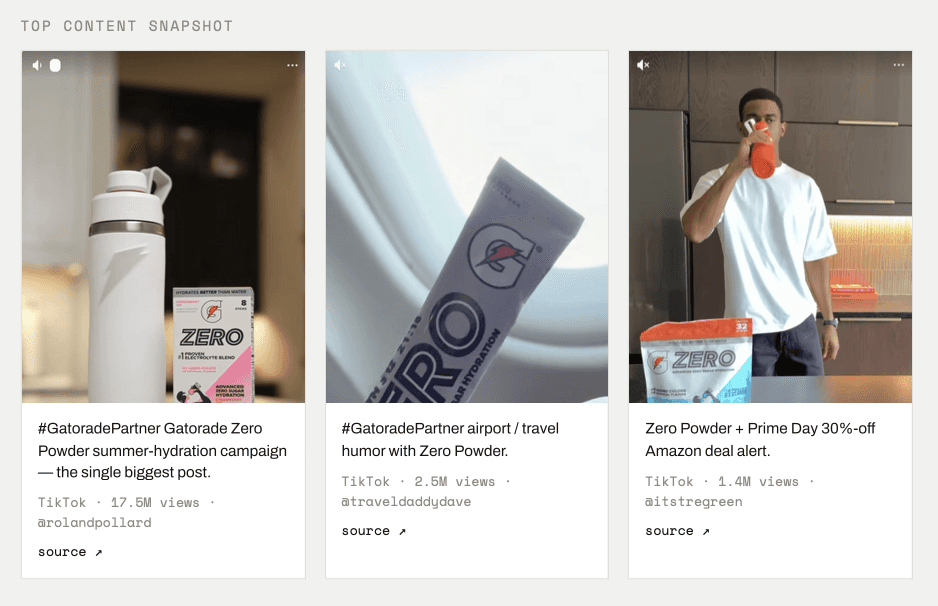
The Electrolyte Powder: Social Intelligence Report compares Gatorade, Liquid I.V., LMNT, Ultima, and DripDrop through volume, sentiment, growth, and topic-level discussion. Taste, ingredients, and price dominate the category conversation. Use the report’s brand deep-dives to examine those priorities and frame a focused question for your team’s next study.
Inside the electrolyte powder research
Find questions in the category conversation.
The Electrolyte Powder: Social Intelligence Report compares Gatorade, Liquid I.V., LMNT, Ultima, and DripDrop through volume, sentiment, growth, and topic-level discussion. Taste, ingredients, and price dominate the category conversation. Use the report’s brand deep-dives to examine those priorities and frame a focused question for your team’s next study.
Get answers before you start.
General
Getting Started
Pricing
Integrations
Security & Privacy
Can social conversations tell us what all consumers think?
No. Collected social posts reflect the people, sources, and query scope represented in the data. Use them to explore language, experiences, and possible needs. Additional research is needed before estimating how common a view is in a wider population.
How does this fit with interviews and surveys?
Social research can help you identify language, contexts, and tensions to investigate. Your team can use those observations to refine an interview guide or survey. Syncly Social does not conduct those studies or validate the resulting hypotheses.
Are the findings based on comments or the video itself?
The available source material depends on the post and source. Supported short-form video analysis examines speech, on-screen text, and visible products alongside captions. Do not assume that a query includes complete comment threads. Confirm the data needed for your study during a demo.
How can we check an AI interpretation?
Ask Hey Syncly about a focused selection of relevant posts, then inspect the cited sources. Look for evidence that supports or challenges the answer, and keep your interpretation distinct from what a person actually said or showed.
Can we compare the experiences around different products?
Yes. Compare same-type product queries with an aligned period and research scope, then inspect the posts behind the differences. Treat those differences as exploratory observations until further research supports a broader conclusion.
Get answers before you start.
General
Getting Started
Pricing
Integrations
Security & Privacy
Can social conversations tell us what all consumers think?
No. Collected social posts reflect the people, sources, and query scope represented in the data. Use them to explore language, experiences, and possible needs. Additional research is needed before estimating how common a view is in a wider population.
How does this fit with interviews and surveys?
Social research can help you identify language, contexts, and tensions to investigate. Your team can use those observations to refine an interview guide or survey. Syncly Social does not conduct those studies or validate the resulting hypotheses.
Are the findings based on comments or the video itself?
The available source material depends on the post and source. Supported short-form video analysis examines speech, on-screen text, and visible products alongside captions. Do not assume that a query includes complete comment threads. Confirm the data needed for your study during a demo.
How can we check an AI interpretation?
Ask Hey Syncly about a focused selection of relevant posts, then inspect the cited sources. Look for evidence that supports or challenges the answer, and keep your interpretation distinct from what a person actually said or showed.
Can we compare the experiences around different products?
Yes. Compare same-type product queries with an aligned period and research scope, then inspect the posts behind the differences. Treat those differences as exploratory observations until further research supports a broader conclusion.


Keep exploring

Find the next insight in social video.

Find the next insight in social video.