Smart Query
Name what you want to hear. The AI does the filtering.
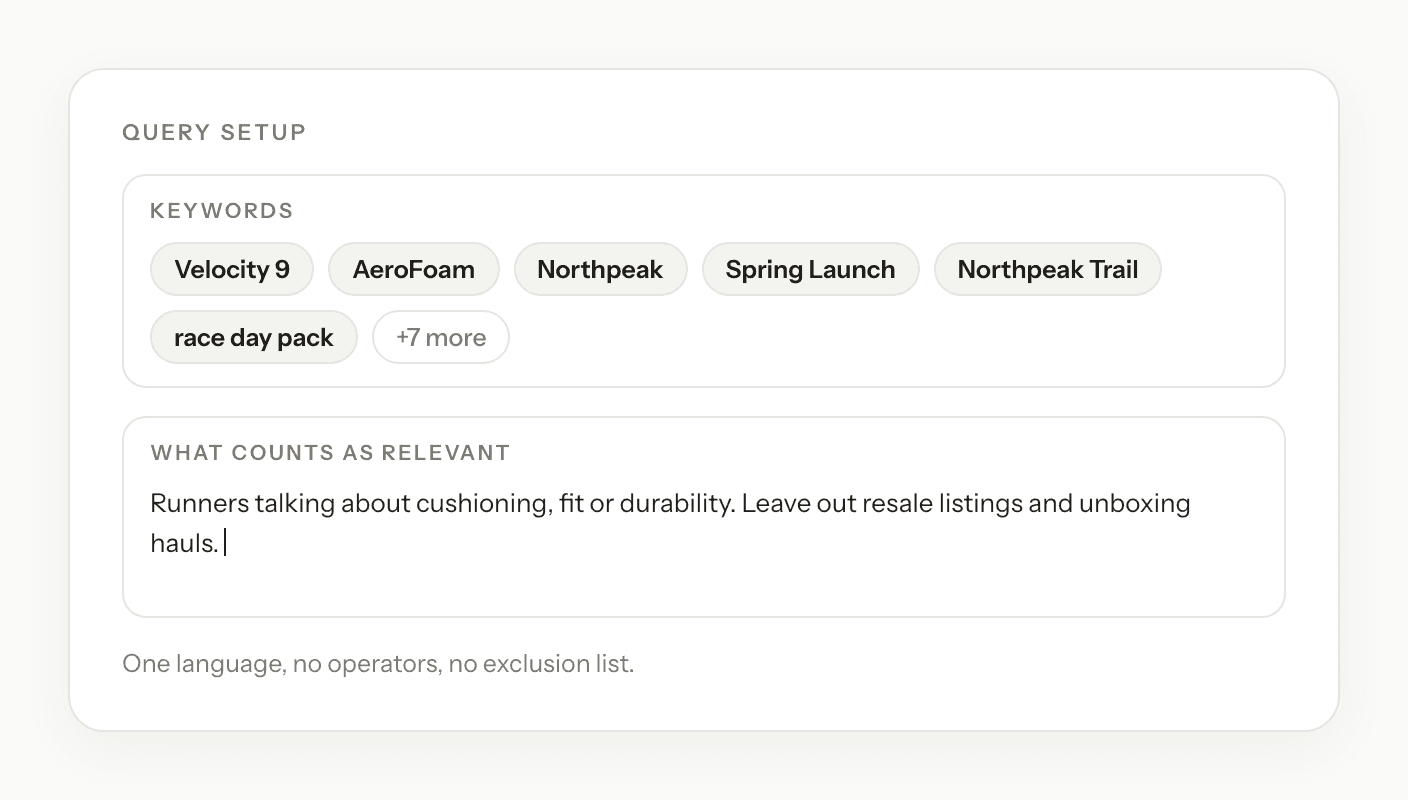
Write a short list of plain keywords in one language. Syncly Social reads every post across languages and keeps what is actually about your topic. Translations, spelling variants, proximity and noise exclusion are its job, not yours.

The input
Same goal. Two very different inputs.
One real listening run, one brief: collect global conversation about a competitor's product launch in every market and every language.

6,702 characters, or 179
Both inputs chase the same posts. Only one of them is a build project.
Boolean query
258 hand-typed terms wired together by 362 operators across 7 nested blocks, including 115 respellings that exist only to beat a tokenizer.
Syncly Social
13 plain keywords in one language and no operators. The AI expands coverage across writing systems and judges relevance post by post.
How it works
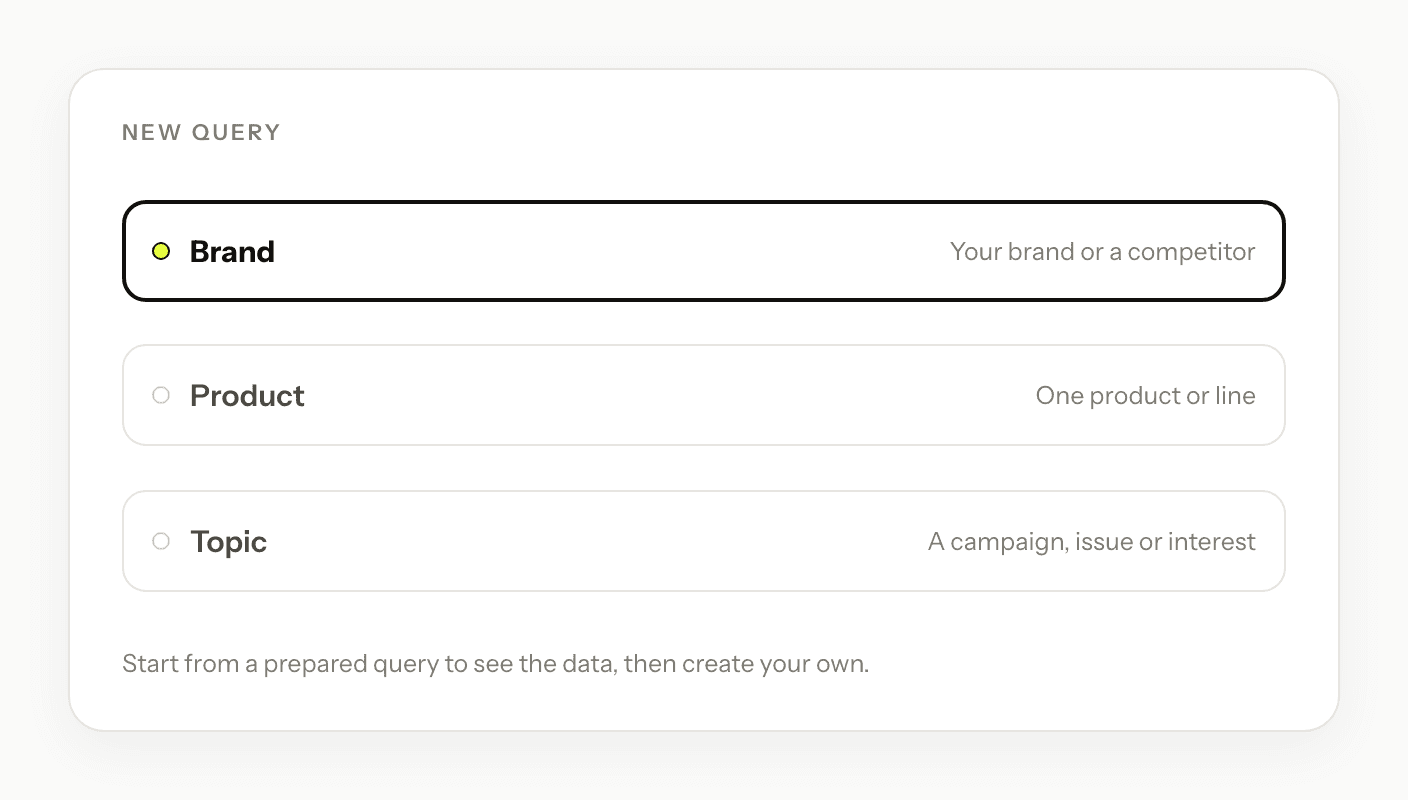
Every analysis starts with a query
A query is where you say what to listen for and how it gets collected. Open one of the prepared queries to see a finished dataset first, then build your own.
3

Capabilities
Define, segment and compare the right data
Smart Query is where you tell Syncly Social what to listen for, then slice and compare it without rebuilding anything.
AI noise filtering
Just describe what matters. Set a prompt for what counts as relevant and the AI filters out the noise to your definition, so you are not maintaining an exclusion list that also voids real posts.

Query segmentation
Slice listening by brand, product or topic, so each question gets its own clean dataset.

Query comparison
Designate Owned versus Competitor and put queries side by side, several at once.

Post and filter
Narrow to the exact posts that matter by platform, promotion type, creator demographics, followers, views or engagement rate.

Always-on ingestion
Syncly indexes viral content continuously, so a new query returns history straight away instead of starting a fetch.

Measured
What string matching quietly loses
Run against the same cycle's real posts, a specialist-built Boolean query missed roughly one in ten of the posts the pipeline itself promoted as signal. Every miss is silent: no error, no gap in the dashboard. The post simply never arrives.
9.5%
of in-scope posts missed by the Boolean query, 61 of 644
9.9%
of top-priority posts missed, 9 of 91 in the run's top 1% by engagement
157
of its 258 terms never matched a single post
Head to head
Boolean query vs Smart Query
Same brief, same platforms. The difference is what each approach asks you to write, and what it does with a post that never names your topic.
How it works
Syncly Social
Boolean query
Setup without operators or parentheses
✓
✕
362 operators in this build
Matches a post that never names your topic
✓
Read in context
✕
Coverage across languages from one keyword list
✓
✕
Every spelling typed by hand
Noise filtering without a hand-written exclusion list
✓
✕
AND NOT also voids real posts
Relevance judged by reading the post
✓
✕
String proximity only
✓ Native · ~ Partial or transcript only · ✕ Not supported
Based on one real listening run in 2026, comparing a specialist-built Boolean query with a Syncly Social keyword list over the same set of posts. This compares how each approach matches posts, not any single vendor's full feature set.
FAQ
Smart Query, answered
The questions teams ask before they give up their Boolean strings.
Do I need to know Boolean to use Syncly Social?
No. You write a short list of plain keywords in one language and the AI handles translations, spelling variants, proximity and noise. There are no operators, parentheses or exclusion lists to build or maintain, so anyone who knows the goal can set up a query.
What happens to a post that never names my brand or product?
Syncly reads the post and judges what it is about, so a post that describes your feature or reacts to your launch without naming it still comes through. String matching has nothing to latch onto in those cases and drops them without any signal that it did.
How does one keyword list cover every market?
You write the list in one language. Syncly expands coverage across writing systems and reads each post in the language it was written in, so you are not typing every spelling of every name in every market.
Can I still narrow results precisely?
Yes. Segment queries by brand, product or topic, designate Owned versus Competitor to compare side by side, and filter posts by platform, promotion type, creator demographics, followers, views or engagement rate.