Hear how people experience your food and drink.
Explore conversations about taste, ingredients, price, and everyday routines. Find relevant product mentions inside social videos and inspect the experience behind the recommendation.
Hear how people experience your food and drink.
Explore conversations about taste, ingredients, price, and everyday routines. Find relevant product mentions inside social videos and inspect the experience behind the recommendation.
Hear how people experience your food and drink.
Explore conversations about taste, ingredients, price, and everyday routines. Find relevant product mentions inside social videos and inspect the experience behind the recommendation.
For brand, social, and consumer insights teams.


For brand, social, and consumer insights teams.
For brand, social, and consumer insights teams.
Brand and consumption occasions
Connect product talk with brand decisions.
Look at taste, value, ingredients, and the occasions behind the conversation.
Hear the words behind a recommendation
Review the taste and product experiences people describe on camera alongside the original video. Explore the language around flavor, value, ingredients, or convenience, then use those specific associations to inform a positioning question or message to test.
Find mentions beyond captions and tags
Explore food and drink references in supported videos, including mentions without a written brand tag. Inspect the occasion, routine, or combination shown, and check whether the reference identifies your brand or relates to the wider category.
Follow the posts you are studying
Review available post metrics and their history to see how a selected food or drink conversation develops. Keep the original content in view when choosing which product experience, presentation, or preparation format deserves closer investigation.
Investigate a specific question
Ask Hey Syncly about selected posts, then return to the cited videos to check how people describe the experience. Use those examples to explore competitive tradeoffs, consumption occasions, or a specific content hypothesis your team will test.


A focused category review
Move from a question to evidence.
Keep comparisons consistent and read the original content before drawing conclusions.
1. Set the brands and question
Define the brands, products, or topics to investigate.
Use consistent comparison periods and source scope.
Check collected posts for relevance to your question.
2. Compare, then inspect
Explore sentiment, conversation, and available performance metrics.
Open posts to hear the language and context.
Ask Hey Syncly about selected relevant examples.
3. Bring evidence into planning
Export the post data your analysis needs.
Include source examples and note open questions.
Choose a message, occasion, or concern to investigate.
Inside the electrolyte powder research
Compare more than the loudest brand.
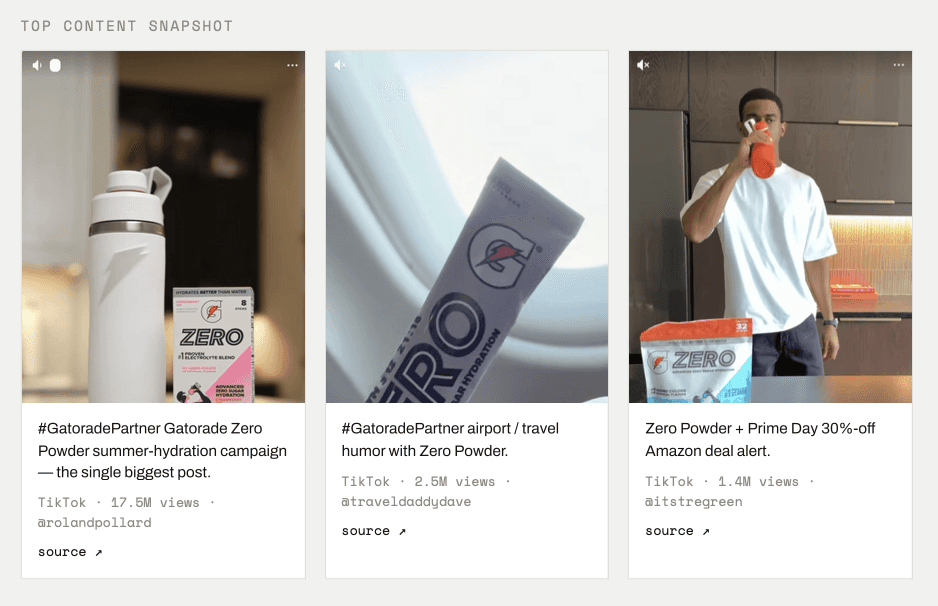
The Electrolyte Powder: Social Intelligence Report compares Gatorade, Liquid I.V., LMNT, Ultima, and DripDrop through volume, sentiment, growth, and topic-level discussion. The rankings change by measure: the largest conversation does not have the most positive sentiment. Taste, ingredients, and price provide context for investigating those differences.
Inside the electrolyte powder research
Compare more than the loudest brand.
The Electrolyte Powder: Social Intelligence Report compares Gatorade, Liquid I.V., LMNT, Ultima, and DripDrop through volume, sentiment, growth, and topic-level discussion. The rankings change by measure: the largest conversation does not have the most positive sentiment. Taste, ingredients, and price provide context for investigating those differences.
Food & beverage reports


Get answers before you start.
General
Getting Started
Pricing
Integrations
Security & Privacy
Can I investigate taste and ingredient conversations?
Yes. Explore recurring language, sentiment, and source posts around the products or topics you track. Inspect what people actually say about flavor, texture, ingredients, and value. These are reported experiences and opinions, rather than objective product tests.
Are spoken opinions and comments analyzed in the same way?
Analysis depends on the source. For supported short-form videos, Syncly can analyze speech, on-screen text, and visual context. Do not assume that means every comment is analyzed. Confirm the sources and analysis you need in a demo.
Does Syncly Social include Amazon review research?
The Functional Beverages: Amazon Review Insights Report is published research that uses Amazon reviews and social conversation. Its sources are different from social-video listening. The report does not establish that Amazon review analysis is part of a Syncly Social subscription. Discuss the scope of a separate research project with the team.
How should I compare brands with different-sized conversations?
Keep the source scope and period consistent, then look beyond the total number of posts. Compare available metrics, sentiment, and discussion topics, and inspect examples behind a difference. Share of voice describes your selected comparison set, rather than the whole food and beverage market.
Can these findings guide product and campaign planning?
Use them to identify consumer language, product concerns, occasions, and ideas worth testing. Bring the source evidence into planning alongside your other research. Social observations do not establish market demand or predict the outcome of a launch or campaign.
Get answers before you start.
Can I investigate taste and ingredient conversations?
Yes. Explore recurring language, sentiment, and source posts around the products or topics you track. Inspect what people actually say about flavor, texture, ingredients, and value. These are reported experiences and opinions, rather than objective product tests.
Are spoken opinions and comments analyzed in the same way?
Analysis depends on the source. For supported short-form videos, Syncly can analyze speech, on-screen text, and visual context. Do not assume that means every comment is analyzed. Confirm the sources and analysis you need in a demo.
Does Syncly Social include Amazon review research?
The Functional Beverages: Amazon Review Insights Report is published research that uses Amazon reviews and social conversation. Its sources are different from social-video listening. The report does not establish that Amazon review analysis is part of a Syncly Social subscription. Discuss the scope of a separate research project with the team.
How should I compare brands with different-sized conversations?
Keep the source scope and period consistent, then look beyond the total number of posts. Compare available metrics, sentiment, and discussion topics, and inspect examples behind a difference. Share of voice describes your selected comparison set, rather than the whole food and beverage market.
Can these findings guide product and campaign planning?
Use them to identify consumer language, product concerns, occasions, and ideas worth testing. Bring the source evidence into planning alongside your other research. Social observations do not establish market demand or predict the outcome of a launch or campaign.


Keep exploring

Find the next insight in social video.


Find the next insight in social video.