How to Measure Untagged Video Mentions on TikTok, Reels, and Shorts
Author :
Luke Bae
Published :
TL;DR: Brands should measure untagged video mentions by separating tagged mentions, text mentions, spoken mentions, and visual mentions, then calculating the incremental coverage found by audio transcription and visual recognition. The goal is to quantify the conversation that tag-only monitoring misses across TikTok, Reels, and Shorts.
Most brand-monitoring dashboards are honest about the data they can see. The problem is that teams often confuse that visible data with the full conversation. A creator can hold up your product, say your brand name out loud, compare it to a competitor, and never tag your handle once.
That post still matters. It may even matter more than a tagged post because it is organic, unprompted, and closer to how consumers actually discover products in video. TikTok's 2026 trend forecast says 2 in 3 users who search on TikTok discover something useful beyond their original intent, and 81% say TikTok provides product information that leads to real-life usage (Source: TikTok Newsroom, 2025). If your measurement model only counts tags and hashtags, you are measuring the easiest part of the market.
What counts as an untagged video mention?
An untagged video mention is any short-form video reference to a brand, product, competitor, or campaign that does not formally tag the brand account. It can appear through spoken audio, captions, on-screen text, packaging, logos, product usage, or side-by-side comparison.
Untagged video mention: a short-form video reference to a brand, product, competitor, or campaign that does not formally tag the brand account, but appears through spoken audio, captions, on-screen text, packaging, logos, or product usage.
This definition is broader than a normal social mention. Brand24 defines social mentions as tagged or untagged references to a brand, product, campaign, or keyword across public channels, and notes that mentions can appear in text, images, videos, comments, and spoken content (Source: Brand24, 2026). YouScan makes a similar point: untagged mentions can include organic brand references, product context, logos, and competitor comparisons even when the brand handle is absent (Source: YouScan, 2025).
For video, brands should treat four signals as separate layers:
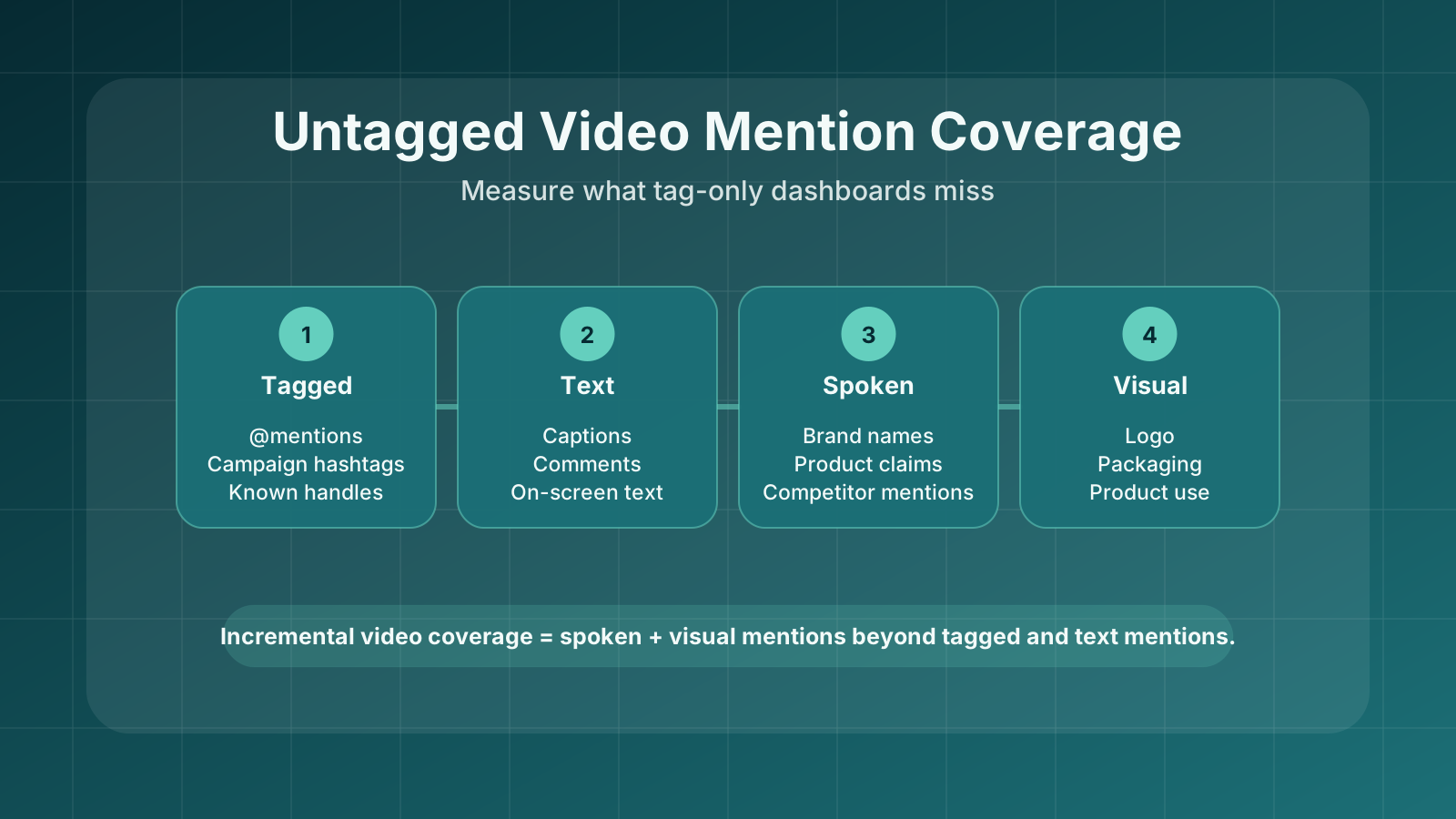
Mention layer | What it captures | Example | Tool requirement |
|---|---|---|---|
Tagged | @mentions, campaign hashtags |
| Basic monitoring |
Text | captions, comments, subtitles, on-screen text | "best sunscreen for oily skin" overlay | Text parsing + OCR |
Spoken | brand, product, or competitor named in audio | creator says "this tastes like Brand X" | Audio transcription |
Visual | logo, packaging, product use, store shelf | product shown without caption mention | AI vision |
The key is not to collapse these into one number too early. A tagged mention and a visual-only mention are both mentions, but they represent different levels of discoverability, intent, and tool coverage. For a deeper explanation of the broader category, see the video social listening guide.
Why tag-only monitoring undercounts TikTok, Reels, and Shorts
Tag-only monitoring undercounts short-form video because consumers and creators rarely structure organic content for brand dashboards. They speak naturally, show products visually, use nicknames, compare alternatives, and skip formal tags.
That creates three blind spots:
Audio blind spot. The brand or competitor is spoken aloud but never typed.
Visual blind spot. The product, packaging, or logo appears on screen without text metadata.
Context blind spot. The post mentions a product benefit, complaint, or comparison without using the brand's exact keyword.
Sprinklr argues that text-only monitoring undercounts brand impact because visual content can show products, logos, stores, and usage without text references. Its visual listening guide cites the common benchmark that up to 80% of brand visuals may not include the brand in captions, comments, hashtags, or metadata, making image and video recognition necessary for complete monitoring (Source: Sprinklr, 2026). Archive, a UGC platform, makes the same operational point from a content-collection angle: non-tagged posts can still contain high-value customer and influencer content that brands miss when they only monitor tags and hashtags (Source: Archive, 2026).
The business cost is not only missed posts. It is distorted decision-making. If your dashboard captures 500 tagged mentions but misses 1,500 spoken or visual mentions, your share-of-voice, sentiment, competitor, and creator reporting are all biased toward the easiest content to detect.
That is why the measurement unit should be total deduplicated video mentions, not tagged mentions. Tag count is a channel-specific subset. It should never be treated as the whole market.
The four-layer framework for measuring untagged video mentions
Teams should measure untagged video mentions with a four-layer framework: tagged, text, spoken, and visual. Then they should calculate how much incremental coverage comes from audio and vision beyond tag-only monitoring.
Use this simple model:
Incremental video coverage = (spoken mentions + visual mentions + text-only untagged mentions) / total deduplicated video mentions
That formula tells you how much of the conversation your traditional monitoring would have missed. It also gives a clean before-and-after story for leadership: "Here is what we saw with tags. Here is what we found once we measured video properly."
Build the workflow in five steps:
Collect the baseline. Count @mentions, hashtags, and campaign tags.
Parse text. Add captions, comments, subtitles, and on-screen text.
Transcribe audio. Capture brand, product, competitor, and category phrases spoken in the video.
Analyze visuals. Detect packaging, logos, product usage, shelf context, and competitor side-by-sides.
Deduplicate and classify. Merge duplicate videos, then classify each mention by sentiment, product attribute, use case, creator tier, and competitor context.
This is where a video-native platform changes the quality of the dataset. Syncly Social uses audio and visual analysis to capture untagged mentions across short-form video, while video analysis helps teams see what is being shown, not only what is typed. That matters when a creator demonstrates texture, fit, taste, packaging, or before-and-after proof without writing the brand name in the caption.
How do you turn untagged mentions into product, creator, and competitor insights?
Untagged mentions become useful when teams classify the context around each mention, not just the existence of the mention. The best outputs connect video mentions to product feedback, creator discovery, campaign planning, and competitor analysis.
At minimum, classify every video mention by:
Sentiment: positive, negative, mixed, neutral
Product attribute: taste, fit, texture, packaging, shade, price, durability, convenience
Use case: tutorial, haul, routine, taste test, comparison, complaint, recommendation
Creator role: customer, affiliate, reviewer, expert, category creator, competitor advocate
Competitive context: direct comparison, dupe claim, category alternative, switching reason
Purchase signal: "worth it", "skip it", "buy this", "my new favorite", "not for me"
This turns untagged mentions from a monitoring metric into an operating system. Product teams can see recurring complaints, while conversation insights help marketing teams see which claims creators repeat unprompted. Influencer teams can find creators already talking about the category. Competitive teams can see where rivals are winning on proof, not just volume.
For TikTok-specific execution, the TikTok social listening guide covers how brands should structure short-form listening programs. For broader vendor evaluation, the top video social listening tools guide shows why text-first platforms and video-first platforms produce different coverage.
Key Takeaways
Untagged video mentions include spoken, visual, text, and contextual references that do not formally tag a brand account.
Tag-only monitoring undercounts TikTok, Reels, and Shorts because many product references happen in audio, visuals, and natural creator language.
The right measurement model separates tagged, text, spoken, and visual mentions before deduplicating the full video conversation.
Incremental video coverage shows how much hidden conversation audio and vision add beyond traditional monitoring.
The business value comes from context classification: product attributes, complaints, praise, recommendations, creator fit, and competitor comparisons.
Conclusion
The most important video mention is often the one your dashboard never counted. A creator says your product name out loud, shows the packaging, compares it to a rival, and moves on. No tag. No hashtag. No clean metadata trail.
That is the measurement problem modern B2C brands have to solve. The winning teams will stop treating tagged mentions as the whole conversation and start measuring the spoken and visual layer where purchase discovery actually happens.
Measure the video mentions your tag-based dashboard misses. Start your free trial with Syncly Social →