Lemme vs. Goli: What 2,150 Social Posts Reveal About the Wellness Gummy Showdown
Author :
Luke Bae
Published :

TL;DR: Across more than 2,150 social posts from June 1–12, 2026, Lemme and Goli look like a tie on sentiment — roughly 79% and 80% positive among posts that take a side. But the conversation underneath is not a tie. Goli wins raw reach (7.4M views vs Lemme's 4.1M) while Lemme wins loyalty by a wide margin (about 120 likes per 1,000 views vs Goli's 19). Goli's volume is heavily driven by affiliate-discount promos and shadowed by counterfeit-product chatter; Lemme's is led by organic taste-and-results advocacy. Mention volume says they are even. The signals below say they are not.
Two wellness-gummy brands, one feed. Open TikTok and you will see both: Lemme's pastel debloat bottles and Goli's red apple-cider-vinegar jars, each promising a better gut and an easier routine.
On the surface they are evenly matched. Pull the social data and both brands sit near 80% positive sentiment — the kind of number a dashboard would call a tie. But "positive" is a ceiling, not a story. It tells you people approve. It does not tell you whether they are advocates or affiliates, whether the love is durable or discount-driven, or what quietly threatens each brand.
So we read the conversation instead of counting it. Using Syncly Social, we analyzed every public post mentioning each brand across TikTok, Instagram, YouTube, Facebook, and X — 965 for Lemme and 1,187 for Goli — over a 12-day window in June 2026. This is an early-window snapshot, not a full-year verdict, but the pattern is already clear: the brands win the same sentiment score for very different reasons, and each carries a risk the other does not.
The scoreboard: even on sentiment, split on everything else
On the headline metric, Lemme and Goli are nearly identical. On the metrics that predict durable demand, they diverge.
Attribute | Lemme | Goli | Edge |
|---|---|---|---|
Posts analyzed (Jun 1–12) | 965 | 1,187 | Goli (volume) |
Polar positive share (pos ÷ pos+neg) | ~79% | ~80% | Tie |
Total views | 4.1M | 7.4M | Goli |
Likes per 1,000 views | ~120 | ~19 | Lemme (6×) |
Lead platform by posts | Facebook, but TikTok drives engagement | TikTok (~50% of posts) | — |
Hero themes | Debloat results, "doesn't taste like a vitamin," sleep | ACV convenience, affordability, zero sugar | — |
Distinctive negative | Minimal (price, one-off noise) | Counterfeit/knockoff risk, store-price complaints | Lemme (cleaner) |
Conversation type | Organic advocacy + skeptic conversions | Affiliate-discount promos, bundle deals | Lemme (more organic) |
The takeaway from the table: Goli is bigger, Lemme is stickier. Raw mention volume — the metric most brands report — would have you believe Goli is winning by ~20%. Engagement quality flips that read.
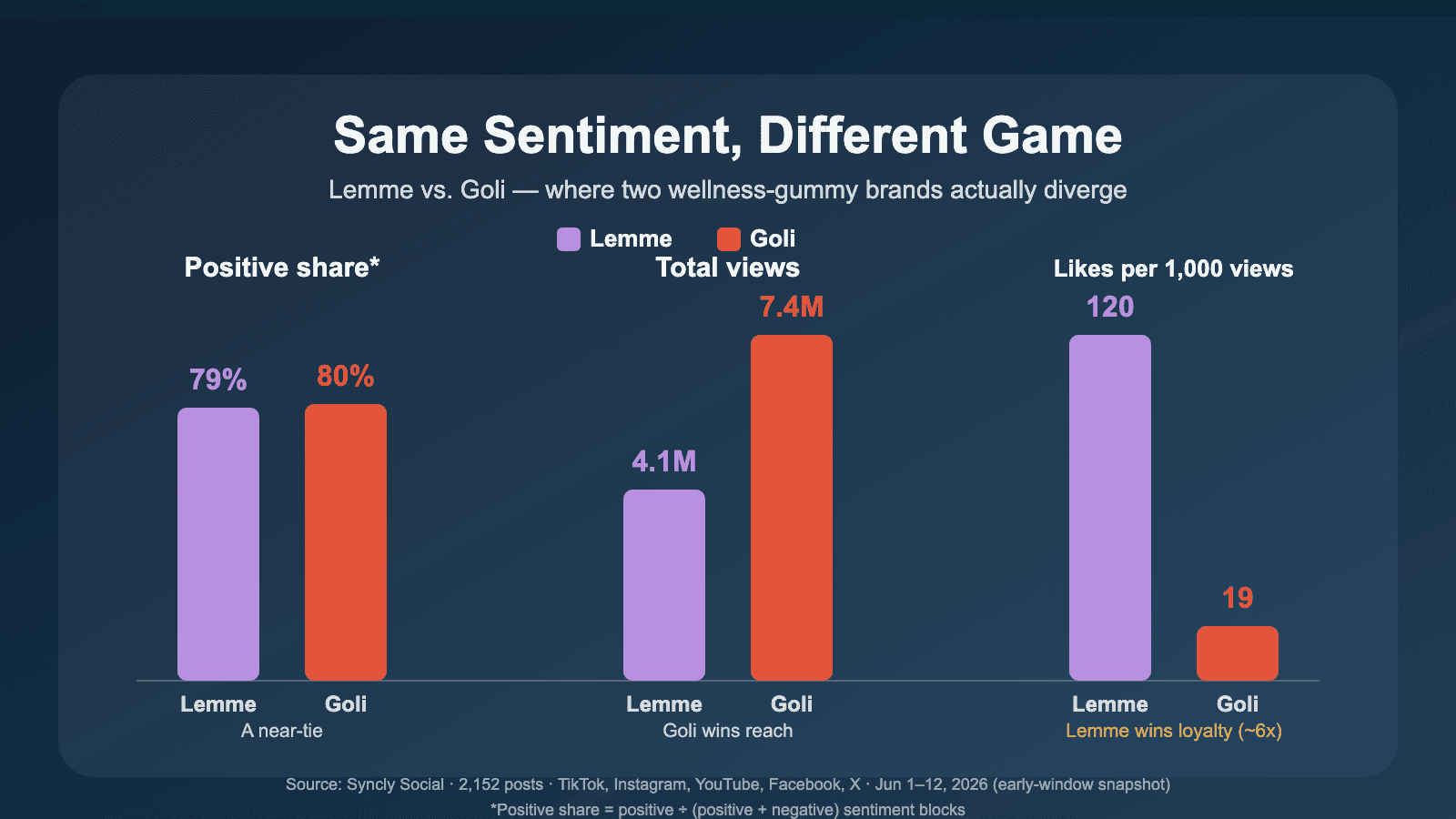
The two brands tie on sentiment (~79% vs ~80% positive), but Goli wins reach while Lemme wins loyalty by roughly 6×. Source: Syncly Social, 2,152 posts across TikTok, Instagram, YouTube, Facebook and X, Jun 1–12, 2026.
For a monthly view of the same two brands, the Syncly Social Index for September 2026 scored Lemme at 47.0 and Goli at 35.5 among wellness brands on short-form video. The index also covers related wellness topics, including the cortisol trend.
Loyalty: Lemme converts skeptics, Goli converts clicks
Lemme wins the loyalty signal because its advocates sound personally invested, not incentivized.
The clearest signal is the like-to-view ratio. For every 1,000 views, Lemme posts earned roughly 120 likes; Goli earned about 19, according to Syncly's analysis of the same period. Goli reaches more eyeballs, but Lemme's audience reacts at roughly six times the rate — a strong proxy for affinity rather than passive exposure.
The content of Lemme's mentions explains why. A recurring pattern is the skeptic-to-convert arc: creators open with "where are my skeptics at?" or admit they assumed the product was "super gimmicky," then describe repurchasing after seeing results. Posts cluster on debloat efficacy, a taste that "doesn't taste like traditional vitamins," easy daily-routine integration, and references to "clinically-studied ingredients" at a $29.99 price several creators frame as good value against $50–60 competitors like Seed or Ritual. That is the shape of organic advocacy: lived experience, repurchase intent, and earned trust.
Goli's positive volume, by contrast, leans heavily on incentive. A large share of its top posts pair praise with a discount code, a "link in bio," or a three-bottle bundle pitched as cheaper than one store bottle. The enthusiasm is real, but it is frequently sponsored enthusiasm — which inflates reach and mention counts without proving the same depth of loyalty. For a brand, that distinction is the difference between a community and a coupon list.
Positioning: a debloat story vs. an ACV-convenience story
Each brand owns a different lane in the conversation, and reads cleanly on its top themes.
Lemme's discussion is anchored by its Debloat product, taste, and sleep support — wellness framed as a pleasant daily ritual. Goli's is anchored by apple cider vinegar as a "you don't have to drink it" convenience play, reinforced by affordability, zero-/low-sugar formulation, and gut-health messaging. Both are coherent. But Lemme's themes are experiential (how it feels, how it tastes, whether it worked), while Goli's skew transactional (price, sugar content, the deal). Experiential themes tend to compound into brand equity; transactional themes compete on the next promo.
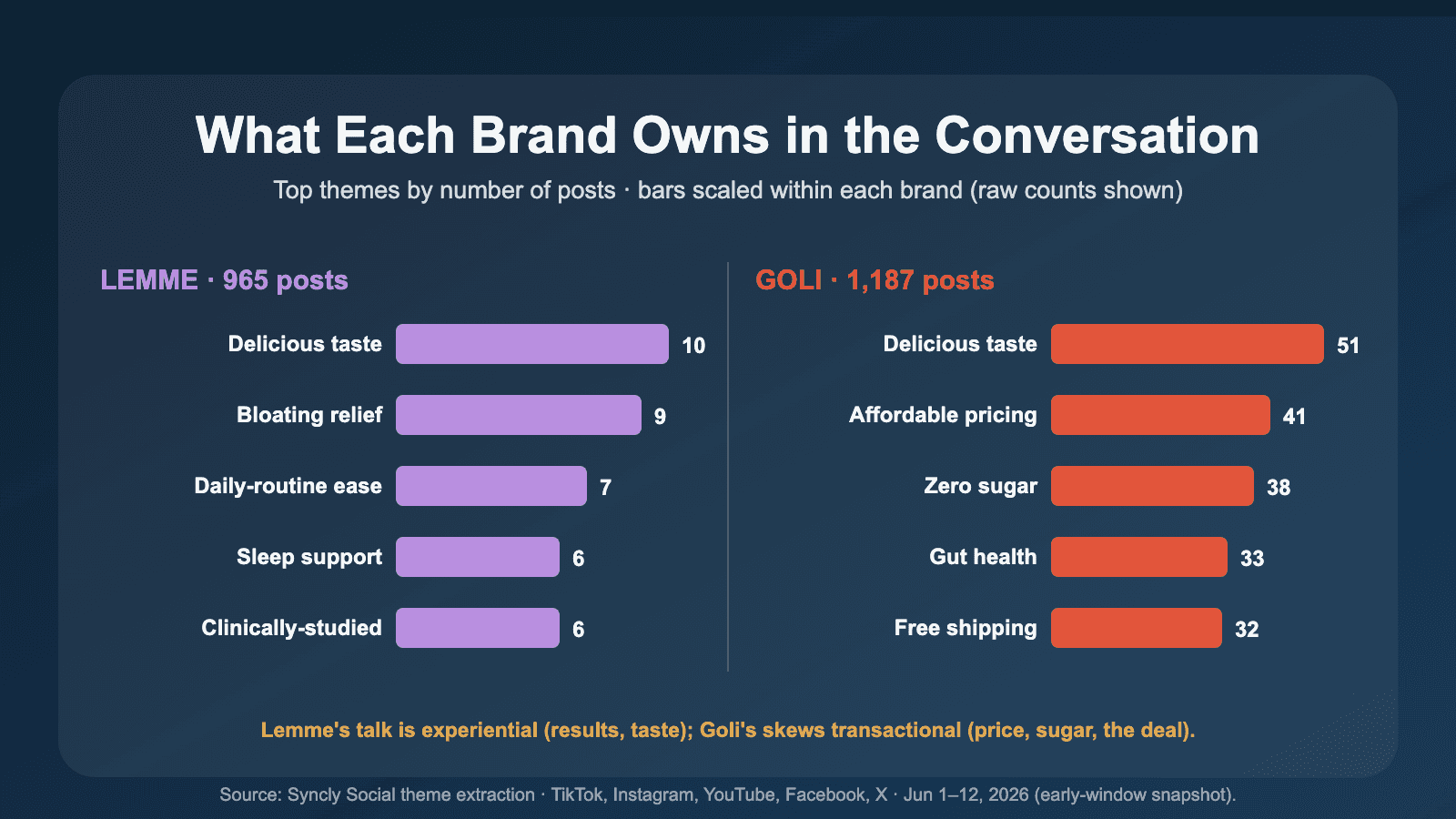
Each brand's top themes by post count. Lemme's are experiential (results, taste, sleep); Goli's skew transactional (price, sugar, free shipping). Source: Syncly Social theme extraction, Jun 1–12, 2026.
It is worth stating plainly, for compliance and for honesty: these are creator and customer claims, not verified brand outcomes. When a creator says a gummy "fixed" their bloating, that is sentiment to monitor, not efficacy to endorse. For wellness brands specifically, reading those claims is also a regulatory early-warning system — the same logic we lay out in the wellness signals playbook.
What the top videos do: organic use vs. affiliate promo
The brands' biggest videos split the same way their loyalty does — Lemme's top clips are creators actually using the product, while Goli's are affiliate discount-code and TikTok Shop promos that rack up views but almost no reaction.
Lemme's hero content is product-in-use. Its single biggest clip pulled 1.7M views and 284K likes — roughly a 17% engagement rate — followed by a "Lemme Sleep" review (877K views, 60K likes) and a fitness creator crediting the brand for debloat ("Lemme products work magic"). People are showing the product and the result.
Goli's hero content is transactional. Its biggest clip drew 2.6M views built around a discount code ("Code: GOLIJUNE… results may vary, consult a doctor") — but engaged at just ~2.6%. Others push "deals for you days" (1.1M views, 0.5% engagement) and "get your bundle in the TikTok Shop" (0.6%). Enormous reach, almost no reaction — promo, not advocacy.
The difference is in the engagement, not the reach: Lemme's hero video engages near 17%, Goli's under 3%. People use Lemme; they discount Goli.
Who drives the conversation: advocates vs. affiliates
The amplifiers differ as sharply as the content — Lemme is carried by genuine creators and its founder's orbit, while Goli's reach comes from affiliate accounts rather than marquee advocates.
Lemme's standout amplifier is the 2.9M-follower creator behind its 284K-engagement clip, alongside other beauty-and-lifestyle creators; the Kardashians' own media account also surfaces, fitting since Lemme is Kourtney Kardashian's brand. The amplification is on-brand and high-affinity.
Goli's amplification comes from the affiliate and discount creators behind its top videos — the same accounts pushing codes and TikTok Shop bundles. No comparable high-affinity advocate carries the brand; its reach is rented, not earned.
The deal-breaker: Goli's counterfeit shadow
The signal that separates these brands is not in the positive column — it is in what each negative conversation is about.
Lemme's negatives are sparse and mostly noise: a stray price complaint, an off-topic mention. There is no organized criticism theme during the window.
Goli's negatives are smaller in proportion but structurally worse. Beyond store-price complaints (creators citing $35 per bottle) and a few sugar-craving and bloating mentions, a distinct theme emerges: counterfeit and knockoff risk. Multiple creators warn that "third-party Chinese brands create fake versions," coach viewers to verify ratings and seller checkmarks, and frame buying through their link as the only safe option. That chatter is partly a sales tactic — but it also means a meaningful slice of Goli's conversation is teaching customers to distrust what is on the shelf. A counterfeit narrative attached to your own category is a trust liability that a mention count will never flag.
This is the face-off's real verdict: not who is more positive, but who is more protected. Lemme's smaller volume hides stronger loyalty; Goli's larger volume hides thinner affinity and an authenticity problem.
Why this read requires video-era listening
None of the signals above survive in a text-only tool, because the conversation lives in video.
Across both brands, the bulk of mentions are short-form video — TikTok alone is about half of Goli's posts and the engine of Lemme's engagement. The decisive details are spoken or shown, not typed: a creator holds a "Lemme Debloat" bottle to camera without captioning the name, recites a discount code out loud, or flashes a store price tag on screen. A keyword crawler records none of it.
Reading a face-off like this one depends on three video-era capabilities:
Audio and on-screen capture — video analysis that reads spoken brand names, shown price tags, and visible packaging.
Theme clustering — conversation insights that group thousands of mentions into "debloat results," "counterfeit risk," or "affordability."
Share-of-voice tracking — a performance monitor view that shows whether reach is organic or promo-driven, and how the two brands trade position over time.
That is the line between social listening and social monitoring: monitoring counts that both brands were mentioned; listening tells you Lemme is building loyalty while Goli is buying reach. For the full platform breakdown, the best TikTok social listening tool guide is the hub.
Key Takeaways
Lemme and Goli are effectively tied on sentiment (~79% vs ~80% polar positive), so sentiment alone is the wrong scoreboard.
Goli wins reach (7.4M vs 4.1M views); Lemme wins loyalty (~120 vs ~19 likes per 1,000 views — roughly 6×).
Lemme's conversation is organic, experiential, and skeptic-converting; Goli's is heavily affiliate- and discount-driven.
Goli carries a distinctive risk Lemme does not: an active counterfeit/knockoff narrative that erodes shelf trust.
The decisive signals are spoken, shown, or promo-coded inside video — invisible to text-only listening.
The verdict is not "Lemme beats Goli." It is that two brands with the same sentiment score are running two different businesses — one compounding loyalty, one renting reach — and only one of them has a trust problem forming in plain sight. Mention volume would have told you they were even. The signals told you who is actually winning.
See what customers really say about your category — across video, not just text. Start your free trial with Syncly Social →