Byoma vs. Good Molecules: What 3,400 Social Posts Reveal About the Budget-Skincare Face-Off
Author :
Luke Bae
Published :

TL;DR: Across more than 3,400 social posts from June 1–12, 2026, Byoma and Good Molecules tie on sentiment — about 82% and 83% positive among posts that take a side. But they are winning different games. Byoma wins the feed: 4.5M views to Good Molecules' 1.8M, carried by TikTok and Reels virality around hydration and glow. Good Molecules wins the comments: roughly 123 likes and 12 comments per 1,000 views versus Byoma's 95 and 4 — about three times the conversation depth — anchored on affordable actives and visible results. Mention volume says Byoma is bigger. Engagement depth says Good Molecules is stickier.
Two budget-skincare darlings, one shelf in everyone's "affordable routine" video. Byoma's pastel barrier-care tubes and Good Molecules' no-frills actives both promise dermatologist-grade results without the prestige price.
On sentiment, they are a dead heat — both land in the low 80s for positive share. But a positive score only tells you people approve. It does not tell you whether they are scrolling past or stopping to argue, whether the love is a quick double-tap or a 40-comment thread dissecting the ingredient list. For two brands fighting for the same budget-conscious shopper, that difference is the whole game.
So we read the conversation instead of counting it. Using Syncly Social, we analyzed every public post mentioning each brand across TikTok, Instagram, YouTube, Facebook, Reddit, and X — 1,928 for Byoma and 1,504 for Good Molecules — over a 12-day window in June 2026. This is an early-window snapshot, not a full-year verdict, but the divergence is already sharp: one brand owns reach, the other owns depth, and only one is being cross-examined in public.
The scoreboard: tied on sentiment, split on engagement
On sentiment the two brands are interchangeable. On how people engage, they are opposites.
Attribute | Byoma | Good Molecules | Edge |
|---|---|---|---|
Posts analyzed (Jun 1–12) | 1,928 | 1,504 | Byoma (volume) |
Polar positive share (pos ÷ pos+neg) | ~82% | ~83% | Tie |
Total views | 4.5M | 1.8M | Byoma (2.5×) |
Likes per 1,000 views | ~95 | ~123 | Good Molecules |
Comments per 1,000 views | ~4 | ~12 | Good Molecules (3×) |
Lead platforms | TikTok + Instagram Reels (viral) | Facebook + Reddit + Instagram | — |
Hero themes | Hydration, barrier support, glow, lightweight feel | Affordable actives: brightening, dark-spot fading, even tone | — |
Distinctive signal | Broad aesthetic virality | Reddit scrutiny + results discussion | — |
The takeaway from the table: Byoma is bigger, Good Molecules is deeper. Reach would crown Byoma by 2.5×. Engagement depth — likes and especially comments per view — flips the read entirely.

The two brands tie on sentiment (~82% vs ~83%), but Byoma wins reach (4.5M vs 1.8M views) while Good Molecules wins engagement depth — ~3× the comments per view. Source: Syncly Social, 3,432 posts, Jun 1–12, 2026.
Reach vs. depth: the feed brand and the comments brand
Byoma wins attention; Good Molecules wins consideration. The two are not the same, and the gap is measurable.
Byoma's 4.5M views are concentrated where skincare goes viral: TikTok and Instagram Reels drove the bulk of its engagement, the formats built for a fast, aesthetic, scroll-stopping first impression. That is awareness at scale — exactly what a brand wants at the top of the funnel.
Good Molecules plays a different game. With less than half the reach, it pulls roughly 123 likes per 1,000 views to Byoma's 95, and about 12 comments per 1,000 views to Byoma's 4 — close to three times the comment density. Comments are the expensive engagement: they signal a viewer stopped to ask "does it actually work on dark spots?" or "is this dupe as good as the $80 version?" That is consideration, the stage where a budget shopper actually decides. A brand that earns three times the questions per view is closer to the purchase, even with a smaller audience.
Positioning: barrier-and-glow vs. affordable actives
Each brand owns a distinct promise in the conversation, and it reads cleanly on its top themes.
Byoma's discussion clusters on hydration, barrier support, a lightweight texture, and glow — skincare framed as gentle, sensory, everyday barrier repair. Good Molecules' clusters on affordable pricing (by far its single biggest theme) plus a results vocabulary Byoma's talk largely lacks: even skin tone, brightening, dark-spot fading, and texture improvement. Both brands are praised as affordable, because affordability is table stakes in this category. The difference is what comes next: Byoma sells a feeling, Good Molecules sells a fix.
That maps directly to the engagement split. A "feeling" brand wins the aesthetic scroll; a "fix" brand wins the comment thread where people compare results. Neither is wrong, but they imply different marketing jobs — Byoma should protect its sensory, barrier-care identity, while Good Molecules should lean into provable, before-and-after results talk.
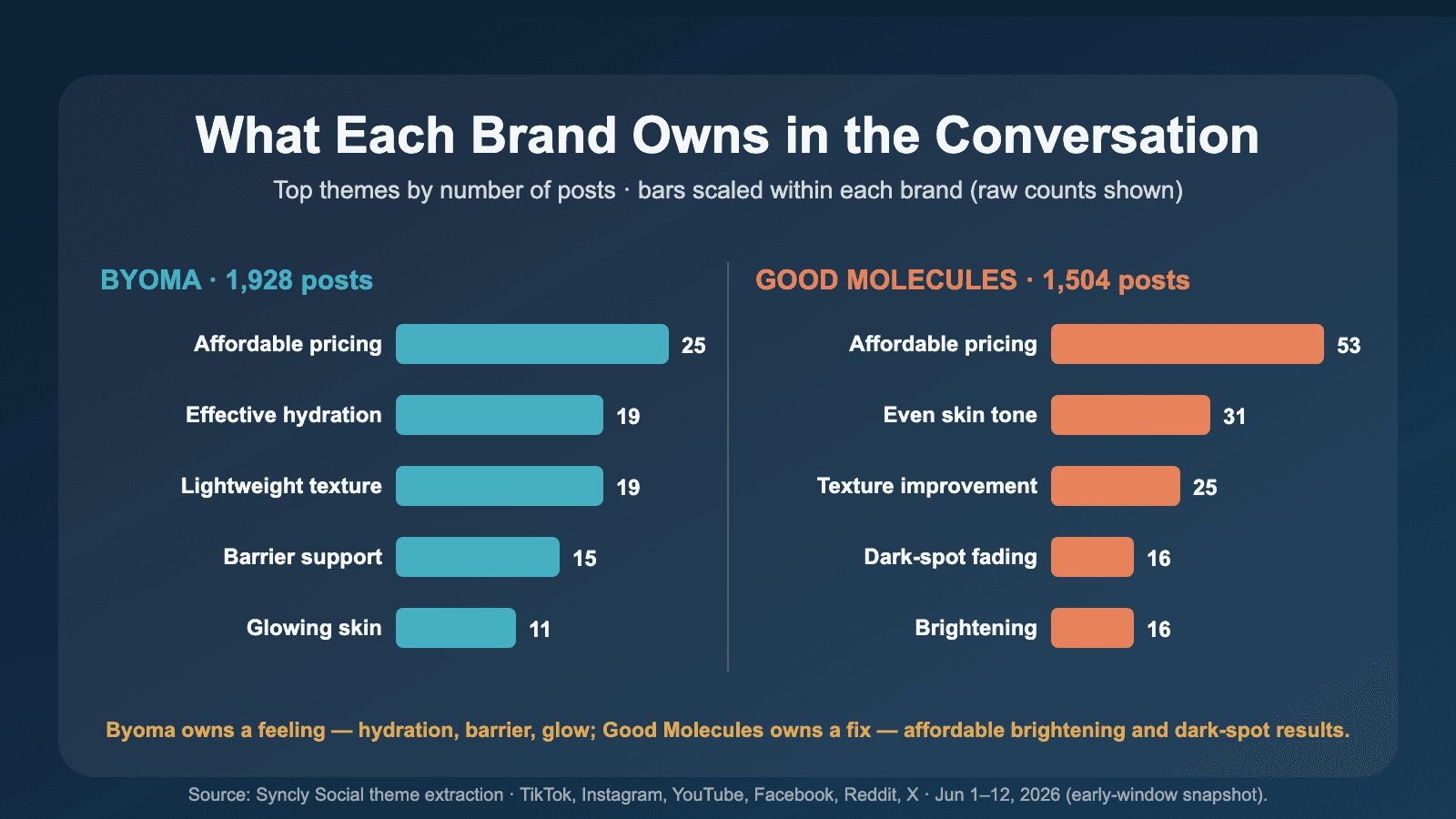
Each brand's top themes by post count. Byoma owns a feeling (hydration, barrier, glow); Good Molecules owns a fix (affordable brightening, dark-spot fading). Source: Syncly Social theme extraction, Jun 1–12, 2026.
It is worth stating plainly, for compliance and for honesty: claims that a product "faded my dark spots" or "fixed my barrier" are creator and customer claims, not verified brand outcomes. They are sentiment to monitor, not efficacy to endorse — and in skincare, tracking that language is also how a brand catches an overpromise before it becomes a complaint. The same early-warning logic powers the beauty backlash signals framework.
For a monthly read on the wider category, the Syncly Social Index skincare ranking for September 2026 placed Anua first with a score of 74.5. See also the index's PDRN trend report from the same month.
What the top videos do: integration vs. sponsorship
The two brands' biggest videos win in opposite ways — Byoma gets woven into creators' own beauty content, while Good Molecules rents reach from a music-festival stage.
Byoma's highest-engagement posts are beauty-native. Its single biggest clip in the window is a pride-themed makeup tutorial that uses Byoma moisturizer as the base — about 86K views, 30K likes, and a ~36% engagement rate, flagged organic. Right behind it sit a summer "get ready with me" and a Target minis haul (117K views, 769 shares). In each, the product is a supporting prop inside content the creator was already making, which is why engagement rates run a remarkable 12–36%.
Good Molecules' top reach comes from a sponsorship, not a skincare demo. Its biggest videos are country musicians posting from the "Good Molecules Reverb Stage" at CMA Fest (one at 170K views, another at 133K), plus a "5-to-9 after my 9-to-5" night-routine vlog at 126K. The reach is real, but most of it is event context — several of those festival clips aren't really about the skincare at all.
That contrast is the mechanism behind the reach-versus-depth split, and it points each brand to its next move: Byoma should seed more creator integrations, while Good Molecules needs to convert borrowed event reach into actual product demonstrations.
Who drives the conversation: beauty ecosystem vs. celebrity reach
Different amplifiers carry each brand — Byoma rides the beauty retail-and-creator ecosystem, while Good Molecules rides bigger celebrities with thinner category fit.
Byoma's highest-impact accounts are category-native: beauty retailers Cult Beauty (1.6M followers) and Sephora Italia (1.3M), beauty creators like Angela Chalet (857K), and an active owned channel (@byoma, 1.4M). These are voices a skincare shopper already trusts on skincare.
Good Molecules' top amplifiers are larger but less native: actress-and-singer Jenna Davis (5.6M followers) and musician Julia Cole (568K), reaching the brand through the CMA Fest tie-in, alongside a smaller owned account (752K). More followers, less skincare authority — which is exactly why Good Molecules' persuasion happens deeper in the comments and on Reddit rather than in its biggest videos. For brands, separating reach from category-relevant advocacy is the core job of competitive analysis.
The deal-breaker: Good Molecules' Reddit jury
The signal that most separates these two brands is not in either positive column — it is where the conversation happens, and who is allowed to push back.
Neither brand has an organized complaint theme in the window; the negatives that exist are thin and scattered (a Byoma dropper or removal gripe, a stray "drying" mention for Good Molecules). But the venue differs in a way that matters. Byoma lives on TikTok and Reels, where the format rewards polish and the loudest negatives are still small relative to reach. Good Molecules carries something Byoma effectively does not: a Reddit footprint — and on Reddit, the brand's mentions skew net-negative, with more critical posts than positive ones in the window.
That is not a crisis; it is a microscope. Reddit is where budget-skincare shoppers interrogate ingredient lists, dupe claims, and longevity before they buy. A brand being scrutinized there is being taken seriously as a contender — but it also means Good Molecules' reputation is being decided in a venue that prizes evidence over aesthetics. The deal-breaker mention volume hides is this: Byoma's reach is broad but shallow, while Good Molecules' smaller volume includes the skeptical jury that actually converts considered buyers.
Why this read requires video-era listening
None of these signals survive in a text-only or single-platform tool, because the conversation is split across video and forum — and most of it is shown or spoken, not neatly tagged.
The decisive details live off-text: a creator holds a Byoma tube to camera without captioning the name, demonstrates a Good Molecules dupe result on screen, or compares both in a spoken "shelfie" tour. Reading a face-off like this depends on three capabilities:
Audio and on-screen capture — video analysis that reads spoken brand names, shown products, and visible results across TikTok, Reels, and Shorts.
Theme clustering — conversation insights that separate "hydration and glow" from "dark-spot fading" so you see what each brand actually owns.
Cross-platform share-of-voice — a performance monitor view that catches the Reddit jury and the TikTok virality in one place, not one screen at a time.
That is the line between social listening and social monitoring: monitoring counts that both brands were mentioned; listening tells you Byoma is winning the feed while Good Molecules is winning the argument. For the full platform breakdown, the best TikTok social listening tool guide is the hub.
Key Takeaways
Byoma and Good Molecules tie on sentiment (~82% vs ~83% positive), so sentiment alone is the wrong scoreboard.
Byoma wins reach (4.5M vs 1.8M views) by getting woven into beauty creators' content; Good Molecules wins depth (~3× comments per view), its top reach borrowed from a CMA Fest sponsorship.
Amplifiers differ: Byoma rides beauty retailers and creators (Cult Beauty, Sephora, @byoma); Good Molecules rides bigger but less skincare-native celebrities (Jenna Davis, musicians).
Byoma owns a feeling — hydration, barrier, glow; Good Molecules owns a fix — affordable brightening and dark-spot results.
Good Molecules carries a distinctive Reddit cohort that skews net-negative: scrutiny that signals serious consideration, not crisis.
The decisive signals are spoken, shown, or buried in forum threads — invisible to text-only, single-platform listening.
The verdict is not "Byoma beats Good Molecules." It is that two brands with the same sentiment score are running different playbooks — one buying awareness in the feed, one earning consideration in the comments — and a budget shopper is converted in the second place, not the first. Mention volume would have told you Byoma was winning. The signals told you who is closer to the sale.
See what customers really say about your category — across video and forums, not just text. Start your free trial with Syncly Social →