Influencer Audit Tools 2026: HypeAuditor vs Modash vs GRIN
Author :
Luke Bae
Published :
TL;DR: The best influencer verification tools for agencies and brands in 2026 are HypeAuditor for audit-grade fraud detection, Modash for self-serve discovery plus verification, CreatorIQ for enterprise governance, GRIN for creator-program workflows, and Upfluence for commerce-heavy teams. The right choice depends on whether you need a dedicated fraud screen, a broader creator operating system, or a workflow that can defend creator quality to clients, finance, and legal before budget is approved.
Most influencer teams still overpay for the wrong signal. They see a clean follower count, a few viral posts, and a polished media kit, then assume the audience is real enough. That is how brands end up paying premium CPMs for creators whose reach is inflated, whose comments are synthetic, or whose followers are technically real but commercially useless.
Verification has become its own buying category because generic discovery filters do not answer the risk question. HypeAuditor frames audience quality as a blend of engagement, audience authenticity, growth, and engagement authenticity rather than a single vanity metric (Source: HypeAuditor, 2026). Modash, Upfluence, and GRIN all push similar manual checks because the problem is operational, not theoretical: before a partnership goes live, a brand needs to know whether the creator's audience is real, reachable, and relevant.
What makes an influencer verification tool different from a discovery platform?
An influencer verification tool is different from a discovery platform because its primary job is risk reduction, not list building. Discovery helps you find creators. Verification helps you decide whether a creator should survive procurement, client review, or finance approval.
Influencer verification tool: software that helps brands or agencies assess whether a creator's audience is real, reachable, and commercially relevant by checking for suspicious followers, abnormal growth, engagement manipulation, and audience-quality risks before a partnership is approved.
That distinction matters because follower count is weak buying logic on its own. HypeAuditor's Audience Quality Score uses a 1-100 scale and explicitly factors in engagement rate, follower growth, engagement authenticity, and audience quality rather than raw size (Source: HypeAuditor, 2026). The same source also defines "mass followers" as real users who follow 1,500 or more accounts. They are not bots, but they are often low-reach and low-attention followers:
Signal | What it means | Why it matters |
|---|---|---|
Fake followers | Bot, purchased, or inauthentic accounts | Inflated reach and low trust |
Mass followers | Real people following 1,500+ accounts | Weak reachability and lower commercial value |
Engagement manipulation | Pods, spam comments, or artificial interaction | Distorts creator performance and skews ROI models |
Upfluence recommends three fast manual screens before outreach: abnormal engagement rates, spammy or irrelevant comments, and unhealthy follower-to-following ratios (Source: Upfluence, 2026). Modash adds profile-level clues such as empty bios, low post volume, and strange network patterns inside the audience sample (Source: Modash Help Center, 2026). If your team already runs a repeatable sourcing process, the broader workflow in influencer discovery from scratch shows where verification fits in the funnel.
The best influencer verification tools for 2026
The best influencer verification tools in 2026 split into two groups: specialist audit tools and all-in-one creator suites with verification layers. The right shortlist is smaller than most listicles suggest.
Tool | Best for | Starting price | Verification strength | Team fit |
|---|---|---|---|---|
HypeAuditor | Fraud-first vetting | Custom | Very high | Agencies, enterprise |
Modash | Self-serve discovery + verification | $199/mo annual | High | Mid-market brands, DTC |
CreatorIQ | Enterprise governance | Custom | High | Global enterprise |
GRIN | Relationship management with basic checks | Custom | Medium | In-house creator teams |
Upfluence | Commerce and affiliate programs | Custom | Medium | eCommerce teams |
1. HypeAuditor
HypeAuditor is the strongest verification-first option on the page. Its fraud-detection explainer says the platform identifies 95.5% of known fraudulent activity and surfaces suspicious growth, audience-quality issues, and comment-level authenticity in one workflow (Source: HypeAuditor, 2025, HypeAuditor, 2025). HypeAuditor also says it covers 224.7M+ creator profiles and is trusted by 8,000+ brands, which supports its position as the most audit-heavy specialist in the group (Source: HypeAuditor, 2026).
2. Modash
Modash is the cleanest self-serve option for teams that want discovery and verification in one product. Pricing starts at $199 per month billed annually, and the platform says it covers 350M+ creators across Instagram, TikTok, and YouTube (Source: Modash Pricing, 2026).
3. CreatorIQ
CreatorIQ is the enterprise suite on the shortlist. Its homepage says it is trusted by 1,300+ brands and that AI-powered discovery helps teams surface the right creators 3x faster (Source: CreatorIQ, 2026). That is less of a specialist fraud pitch and more of a governance pitch: permissions, workflows, multi-market scale, and defensible program operations.
4. GRIN
GRIN is strongest when verification needs to live inside a broader creator-relationship workflow. Its free fake-influencer checker focuses on practical warning signs such as shallow comments, low originality, and unusual activity across TikTok, YouTube, and Instagram (Source: GRIN, 2026). That makes GRIN useful for in-house teams that do not want a separate audit-only stack.
5. Upfluence
Upfluence sits in the middle: more operational than audit-heavy, more commerce-aware than generic discovery. Its guidance on comment spam, abnormal engagement, and unhealthy ratios is pragmatic and easy for non-analysts to use (Source: Upfluence, 2026).
How should teams compare influencer verification tools beyond follower counts?
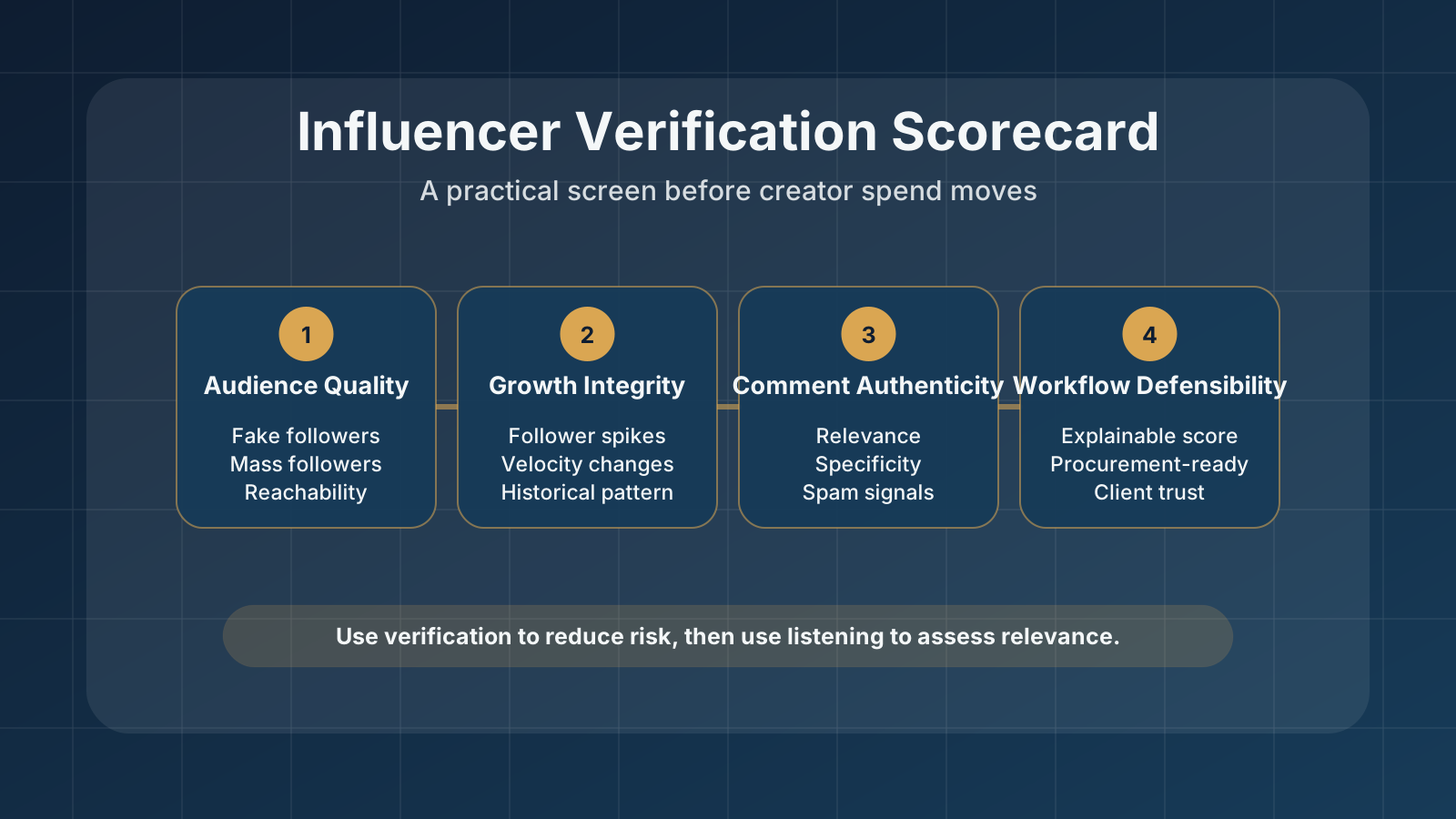
Teams should compare verification tools on audience quality, growth integrity, comment authenticity, workflow defensibility, and how easy the output is to explain internally. Raw reach is the least useful column in the spreadsheet.
Start with the signals that survive scrutiny:
Audience quality score or equivalent. A single composite metric is not enough, but it is a good summary layer when backed by transparent components.
Growth integrity. Sudden spikes without a content or campaign explanation are stronger warning signs than soft engagement changes.
Comment authenticity. Generic praise, emoji spam, and off-topic repetition are still some of the fastest manual catches.
Reachability. A real audience can still be commercially weak if it is overloaded with mass followers.
Workflow defensibility. Agencies need outputs they can put in a client deck. In-house teams need outputs procurement and leadership will trust.
The practical test is whether the tool turns a screenshot debate into a repeatable scorecard. HypeAuditor's AQS is useful here because it combines multiple quality indicators into a framework that is easy to explain upward (Source: HypeAuditor, 2026). Modash is useful for the opposite reason: it keeps the workflow self-serve and transparent enough for operators who move fast and do not want analyst bottlenecks (Source: Modash Help Center, 2026).
This is also where brands should stop confusing "numerically clean" with "strategically relevant." A creator can pass every fraud screen and still be the wrong fit because the content is off-message, the product usage is shallow, or the creator only intersects your category in captions. That is why a broader content-first creator discovery layer matters alongside verification. It helps teams evaluate what creators actually say and show, not only whether their audience graph looks credible.
When do brands need a standalone verification tool vs an all-in-one discovery platform?
Brands need a standalone verification tool when the cost of being wrong is higher than the cost of adding another layer. They need an all-in-one suite when speed, workflow simplicity, and creator operations matter more than specialist fraud analysis.
Choose a dedicated verification tool when:
creator budgets are large enough to justify formal due diligence
the creator will be presented to a client, leadership, or finance committee
the partnership is long-term, multi-market, or reputation-sensitive
the team needs a defensible audit trail instead of ad hoc screenshots
Choose a broader suite when:
the team is lean and wants discovery, outreach, and verification in one UI
the creator program is commerce-heavy and tied to affiliate workflows
the team values speed and operator convenience over specialist scoring depth
For many brands, the answer is not either-or. The better 2026 stack is a discovery system plus a verification layer plus a relevance layer. Verification tells you whether the audience is real. Discovery tells you whether the creator is available. A listening layer such as Syncly Social or Ask Syncly tells you whether the creator is actually present in the category conversation and how they talk about products on video. That becomes more important as teams scale programs, which is the exact problem addressed in how to scale influencer discovery.
The mistake is buying a verification tool and assuming the job is finished. Fraud prevention is one screen. Relevance, resonance, and creator fit are separate screens. The best teams run all three before budget moves.
Key Takeaways
The best influencer verification tools in 2026 are HypeAuditor, Modash, CreatorIQ, GRIN, and Upfluence, but they solve different levels of risk and workflow complexity.
Follower count is a weak buying signal. Audience quality, growth integrity, comment authenticity, and reachability are stronger criteria.
Teams should distinguish fake followers, mass followers, and engagement manipulation because each creates a different kind of commercial risk.
Dedicated verification tools are worth it when creator budgets, client scrutiny, or reputational stakes are high.
Verification is not the whole workflow. The strongest stack pairs fraud screening with discovery and content-level relevance analysis.
Conclusion
The best influencer verification tool is not the one with the biggest database. It is the one that gives your team a repeatable reason to say yes or no before money leaves the budget.
That usually means a specialist like HypeAuditor for audit depth, a flexible operator tool like Modash for self-serve workflows, or an enterprise suite like CreatorIQ when governance matters more than price transparency. But the bigger shift is this: brands no longer win by checking whether a creator looks clean on paper. They win by checking whether the creator is clean, relevant, and trusted by an audience that can actually be reached.
See which creators are shaping your category conversation before they ever fill out a media kit. Start your free trial with Syncly Social →