2025 Holiday Shopping Recap: Social Video Insights + Strategy
Author :
Luke Bae
Jan 9, 2026


This 2025 holiday shopping recap is grounded in short-form social video listening across TikTok and Instagram Reels. We analyzed creator videos using spoken-word transcripts, captions, and repeated content formats to identify the season’s most consistent behavioral and sentiment patterns.
The headline insight: holiday spending didn’t freeze. It evolved. Shoppers became more calculated, optimizing for control (budgeting), convenience (delivery + pickup), and emotional payoff (self-gifting).
Methodology: Short-form Social Video Listening (TikTok + Instagram Reels)
This analysis synthesizes themes from the provided dataset of short-form social videos using:
Transcripts (what creators say out loud)
Captions + on-screen text (what they frame as the hook)
Recurring formats (haul, unboxing, GRWM, store walkthroughs, gift guides)
Behavioral evidence (in-store footage, pickup workflows, shopping pain points)
Here's how the high-level metrics unfolded in this analysis:
Total Volume: 2,147 posts (TikTok leads with 1,172 vs. Instagram 975)
Total Views: 368.4M (TikTok dominates with 342.8M views vs. Instagram 25.6M)
Engagement: 7.3M total (TikTok drives 6.9M, indicating higher viral potential)
2025 Holiday Shopping Recap: The Rise of the “Calculated Shopper”
Holiday 2025 was defined by a contradiction that showed up repeatedly in social video:
Economic anxiety (prices, household budgeting pressure)
Strategic spending (shopping earlier, optimizing deals, limiting impulse)
Small treat behavior (self-gifting as emotional regulation)
Shoppers weren’t saying, “I’m not spending.” They were saying, “I’m spending differently.”
Social video evidence (gift-on-a-budget framing):
Capital One budget gifting tips: https://www.tiktok.com/@capitalone/video/7581950291411619085
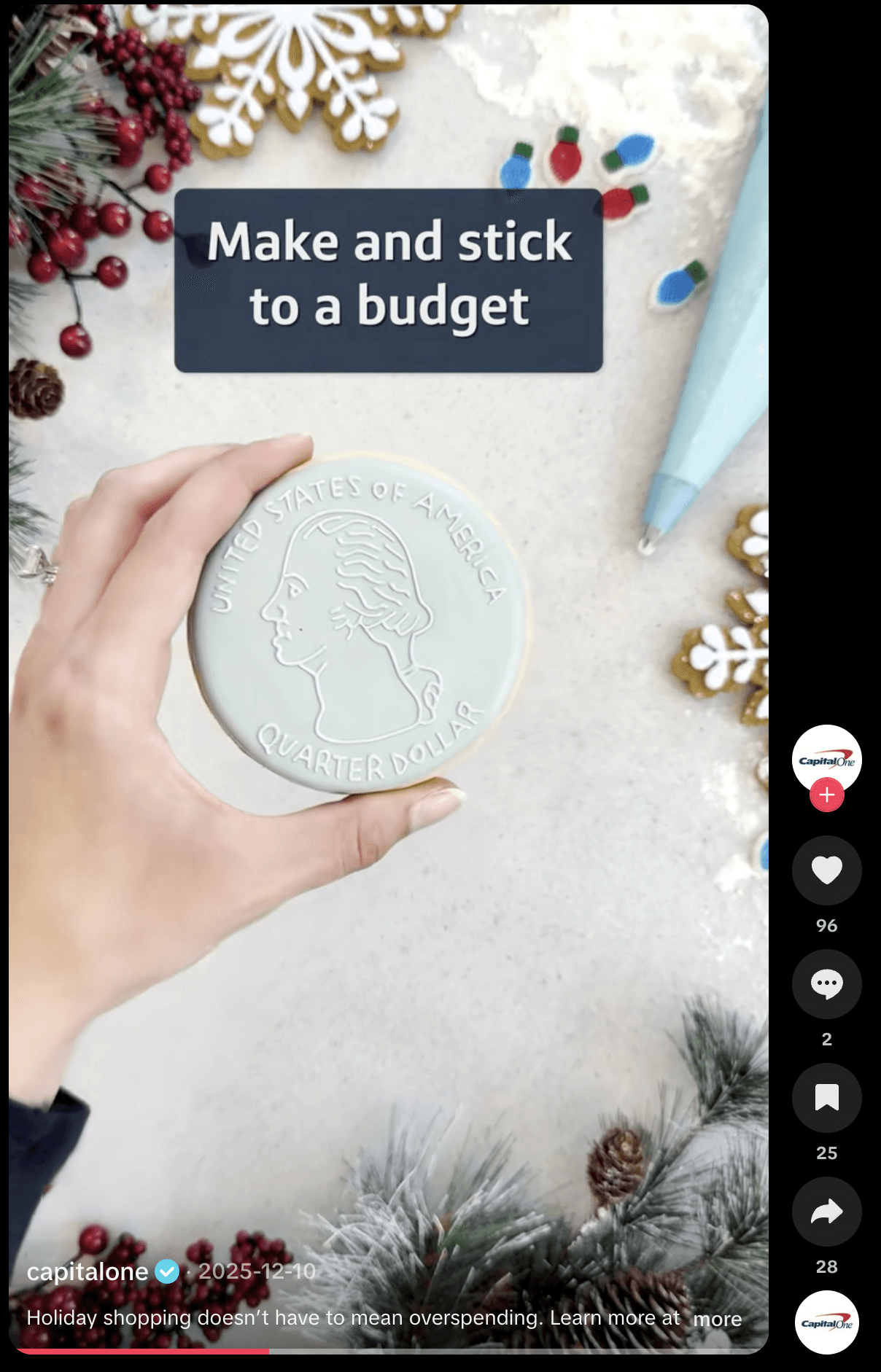
Content Summary (generated by Syncly AI): The content creator shares tips to make the holidays magical while staying on budget.
Holiday Shopping Trends 2025: Early Planners vs Last-Minute Rescue Shoppers
Short-form videos made one thing obvious: the season split into two different shopper journeys.
Segment 1: Early Planners (“Finishers”)
Creators framed early shopping as a lifestyle win—peace, organization, and less stress.
“Done before December” = status + sanity
Curated lists and one-stop shops reduce decision fatigue
Evidence (early shopping haul framing):
Walmart early holiday shopping: https://www.instagram.com/reels/DRP-0xCiUTT/
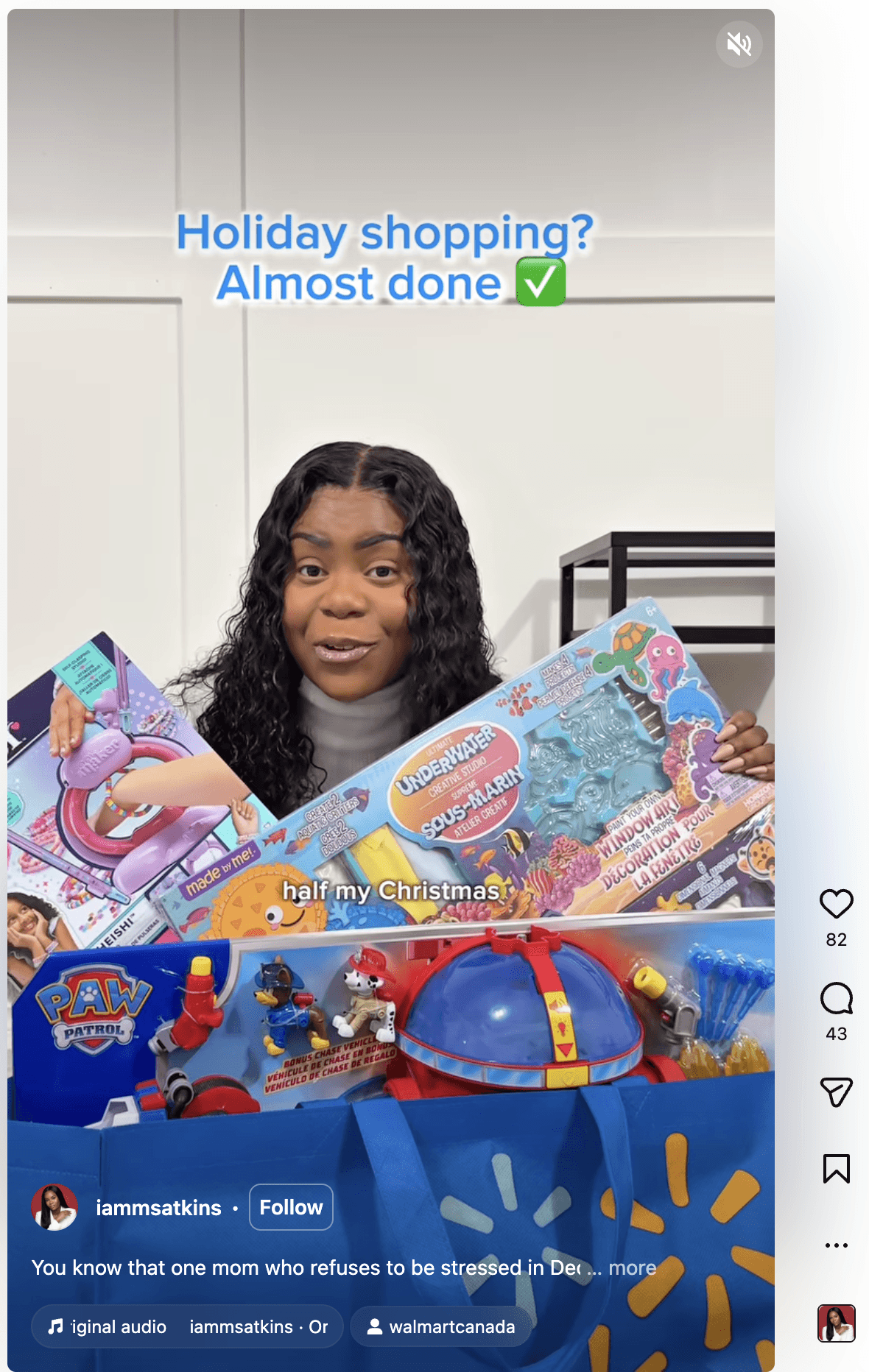
Content Summary (generated by Syncly AI): The content creator shares her early holiday shopping haul from Walmart, featuring gifts for her nieces and son.
Segment 2: Last-Minute Rescue Shoppers
Late shoppers weren’t optimizing price as much as optimizing certainty:
in-stock availability
delivery speed
low-effort gift solutions (bundles, stocking stuffers, “grab-and-go”)
Evidence (last-minute store run + chaos):
Target/TJ Maxx/Sam’s Club last-minute shopping: https://www.tiktok.com/@_mariclaremaclamroc_/video/7586792286122511671
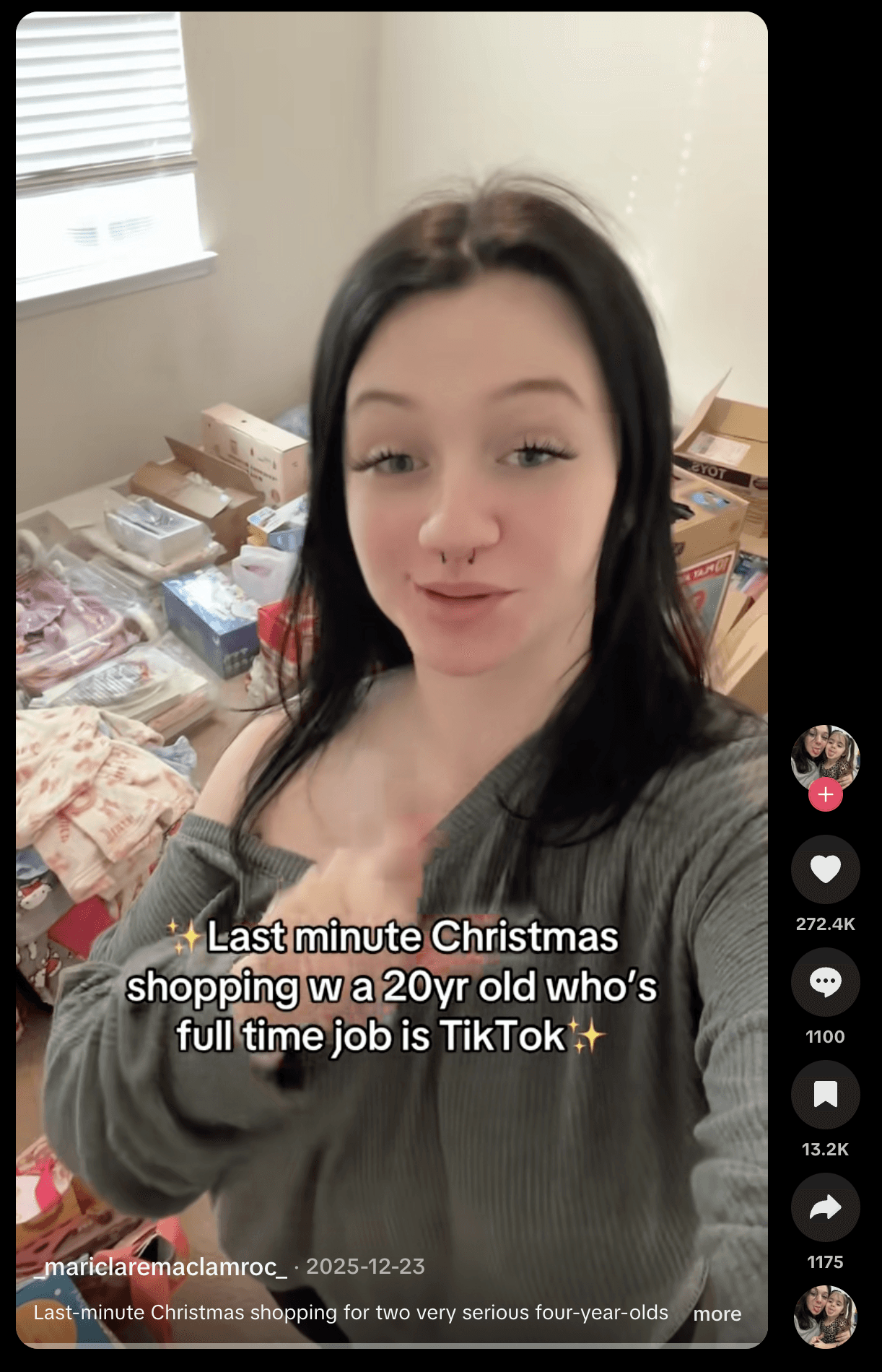
Content Summary (generated by Syncly AI): A content creator documents their last-minute Christmas shopping trip for two four-year-olds at Target, TJ Maxx, and Sam's Club.
Marketing implication: Run two funnels.
Planner funnel: early access, curated gifts, “finish early” messaging
Rescue funnel: shipping cutoffs, BOPIS, express delivery, “gift in minutes” bundles
Holiday Consumer Behavior 2025: Budgeting Became a Ritual
Budgeting wasn’t just a constraint—it became content. Shoppers shared tactics and mindset rules:
spend-per-person caps
list-making and strict prioritization
“experiences over things” as a budget-safe narrative
Evidence (macro-to-wallet explanation + household spending pressure):
Tariffs + household budget stress: https://www.tiktok.com/@sheisapaigeturner/video/7576360223770758414
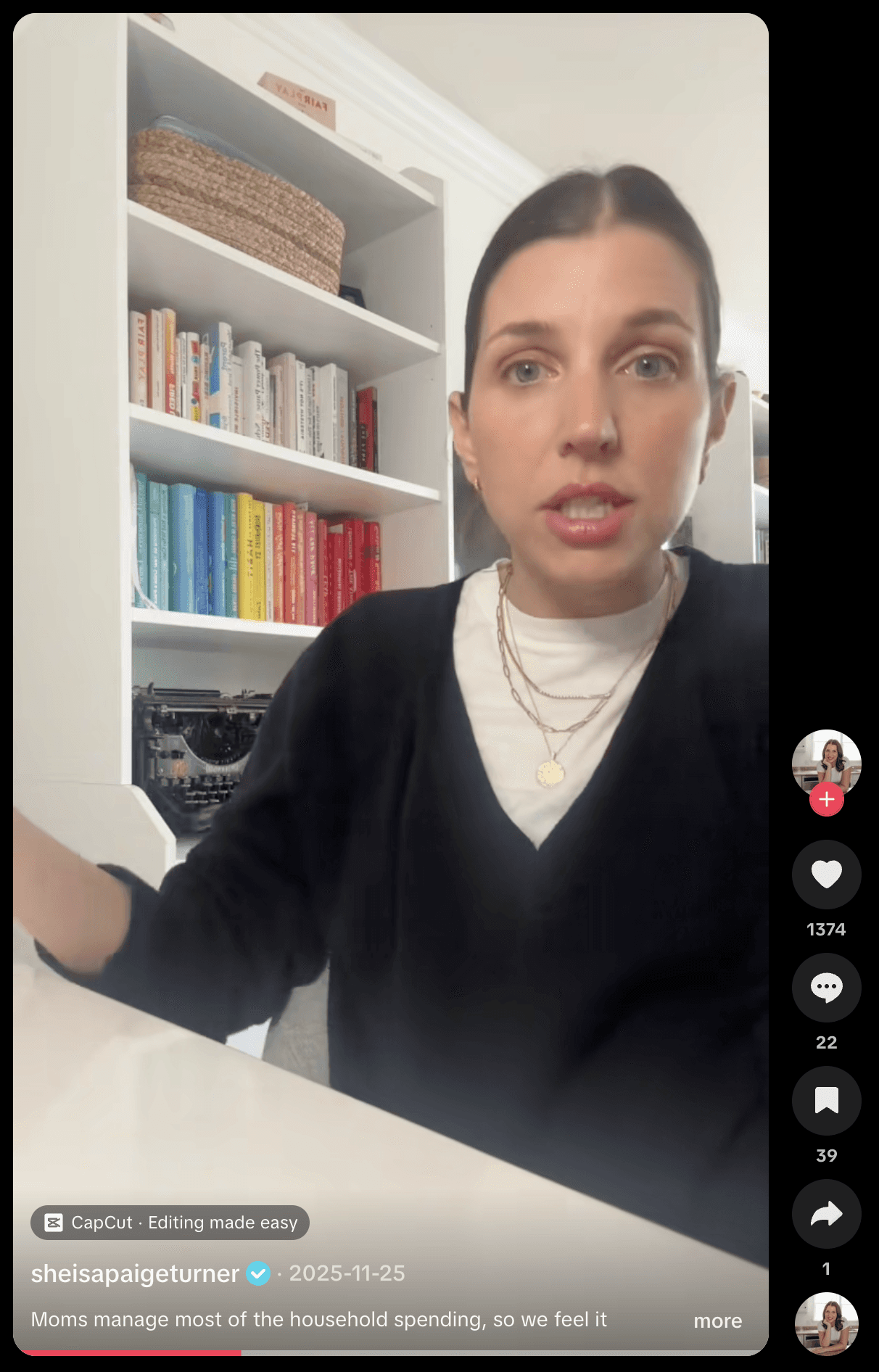
Content Summary (generated by Syncly AI): The content creator discusses how tariffs are driving up the cost of everyday goods and impacting families' budgets.
Marketing implication: If you want conversion, don’t just say “sale.”
Show why it’s worth it (value proof, utility, durability, bundle economics).
Self-Gifting Trend 2025: “Treat Yourself” as a Conversion Driver
Self-gifting wasn’t an afterthought—it was a conversion lever. Creators repeatedly normalized:
“Don’t forget yourself”
adding small items during gift shopping
low-ticket “little treats” as emotional payoff for holiday labor
Evidence (“treat yourself too” positioned as part of gifting):
Amazon “11 cent deal day” gifting + self treat: https://www.tiktok.com/@okaylookingdude/video/7571479169347947806
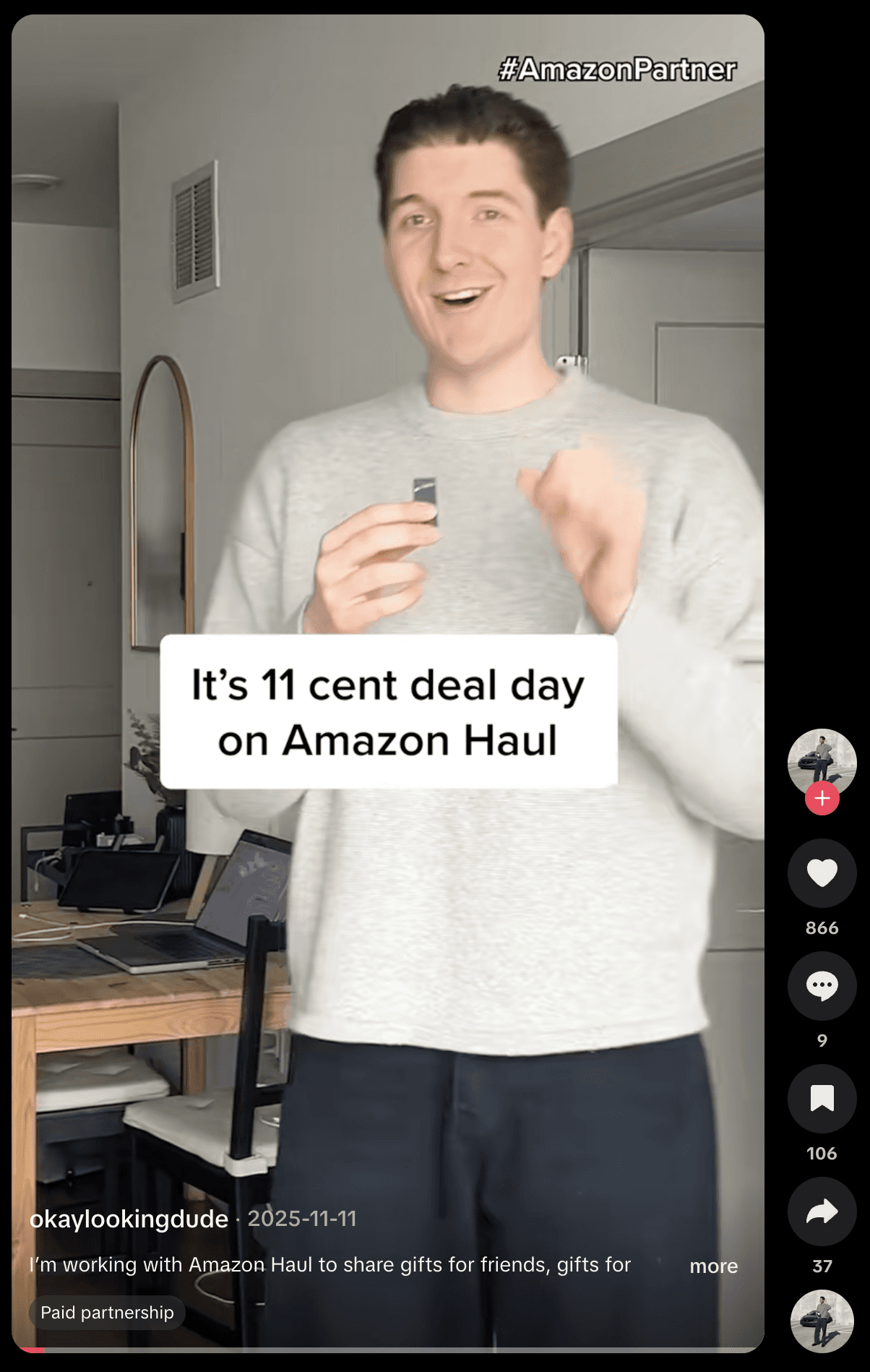
Content Summary (generated by Syncly AI): The content creator discusses how tariffs are driving up the cost of everyday goods and impacting families' budgets.
What marketers should do:
Add a “Pick a little treat” module at checkout (AOV lift)
Build “Gift + Treat” bundles (guilt-reduction = higher conversion)
Use offer framing that validates the shopper’s effort (“you earned this”)
The Mall Comeback: Why Social Video Pulled Shoppers Back In-Store
A strong holiday signal: in-store shopping returned as experience + content.
Mall trips were filmed as a social ritual (“sister date,” festive vibes)
Physical retail became a content backdrop for “shop with me” formats
Visual merchandising mattered because it became shareable media
Evidence (mall as vibe + social ritual):
“Meet me at the mall” holiday shopping: https://www.tiktok.com/@meriahchristine1/video/7579031424758566174
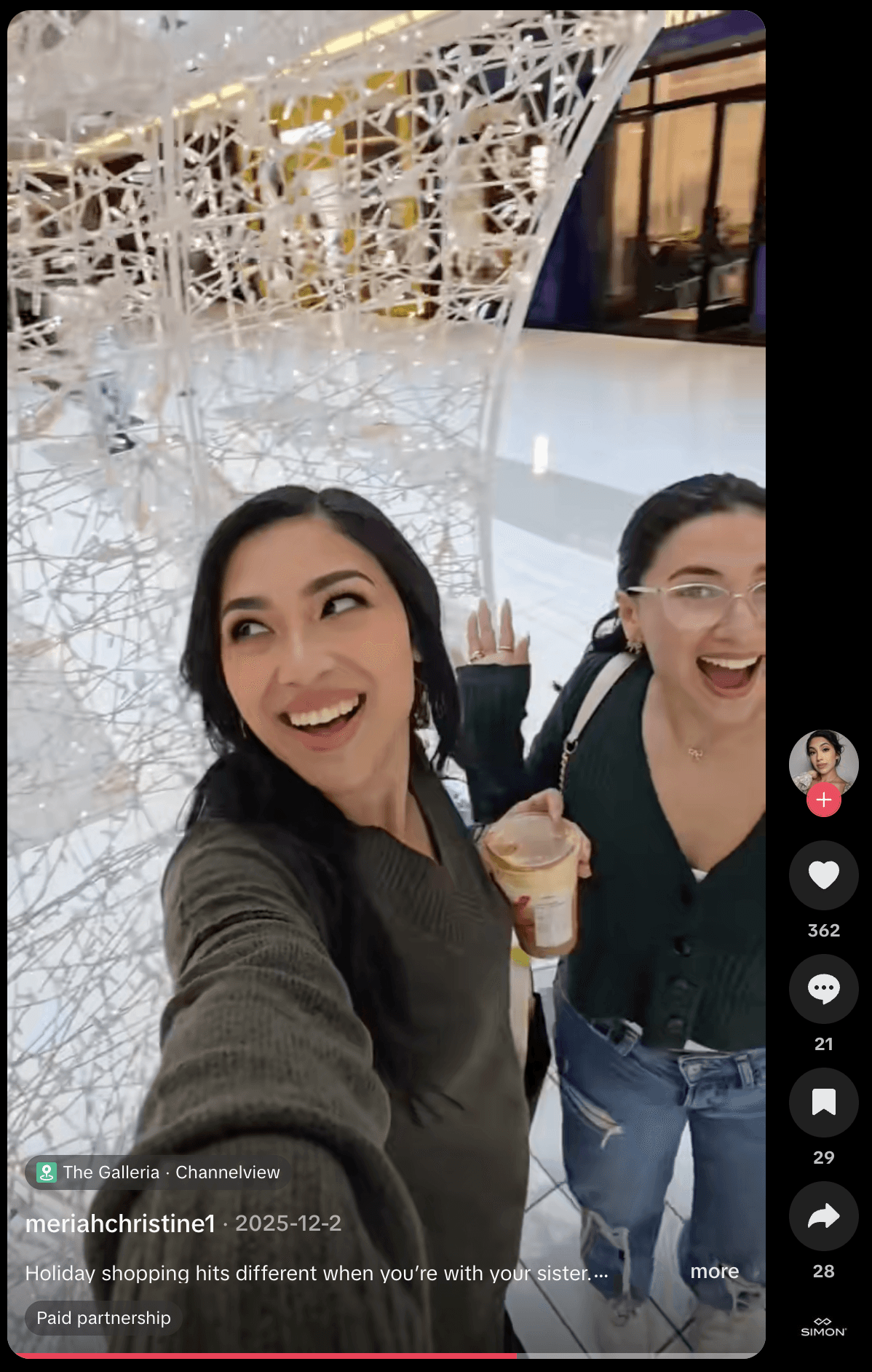
Content Summary (generated by Syncly AI): The content creator discusses how tariffs are driving up the cost of everyday goods and impacting families' budgets.
Marketing implication: Stores aren’t just distribution. They’re a media channel.
For the 2026 Holiday Shopping Season, Brands should design for:
“filmable” curated gift corners
obvious giftable moments
quick, confidence-building wayfinding
Holiday Shopping Pain Points: Burnout, Overstimulation, Decision Fatigue
Short-form video captured real friction—especially for parents:
overcrowded aisles and overstimulation
decision fatigue from endless options
the mental load of managing family gifting
Evidence (overwhelm + preference for curated solutions):
Nordstrom curated lists + easy pickup + easy returns: https://www.tiktok.com/@sydneyschiffer/video/7585282386997398797
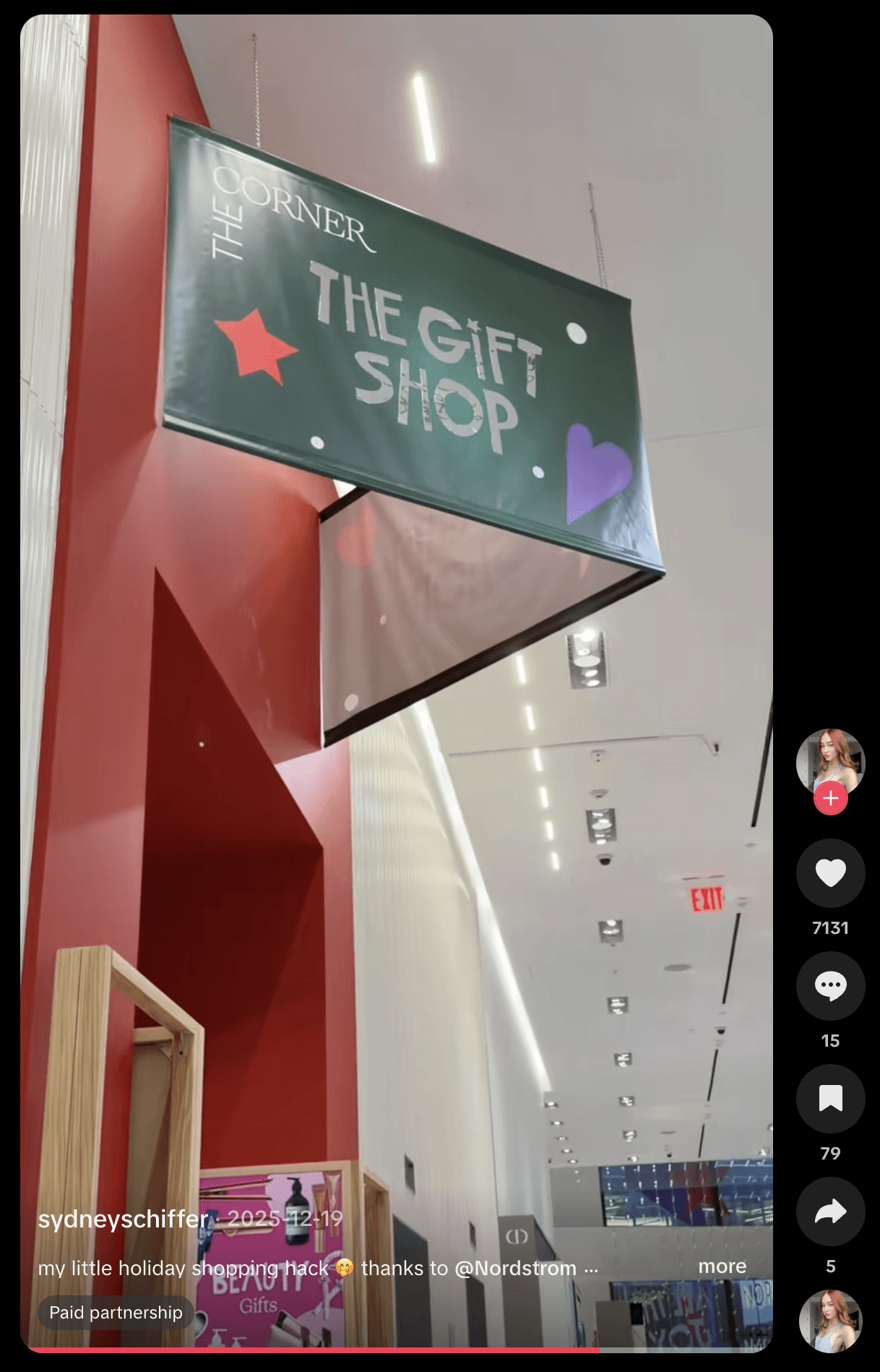
Content Summary (generated by Syncly AI): The content creator promotes Nordstrom as a great place to shop for holiday gifts, both online and in-store.
Marketing implication: Convenience is not a feature. It’s a premium benefit.
Highlight:
curated gift lists
BOPIS speed
returns clarity
“stocking stuffer bundles” and “gift-ready sets”
What Worked in 2025: Value Density vs Vibe Density
Winning holiday strategies are clustered into two lanes:
1) Value Density (Extreme value per frame)
Hauls succeed when a creator can show many items for a low total. Discount retailers thrive because “visual abundance” drives engagement
Evidence (under $20 gift haul):
Ross Disney gift ideas: https://www.tiktok.com/@jordynsleek/video/7580064190086270222
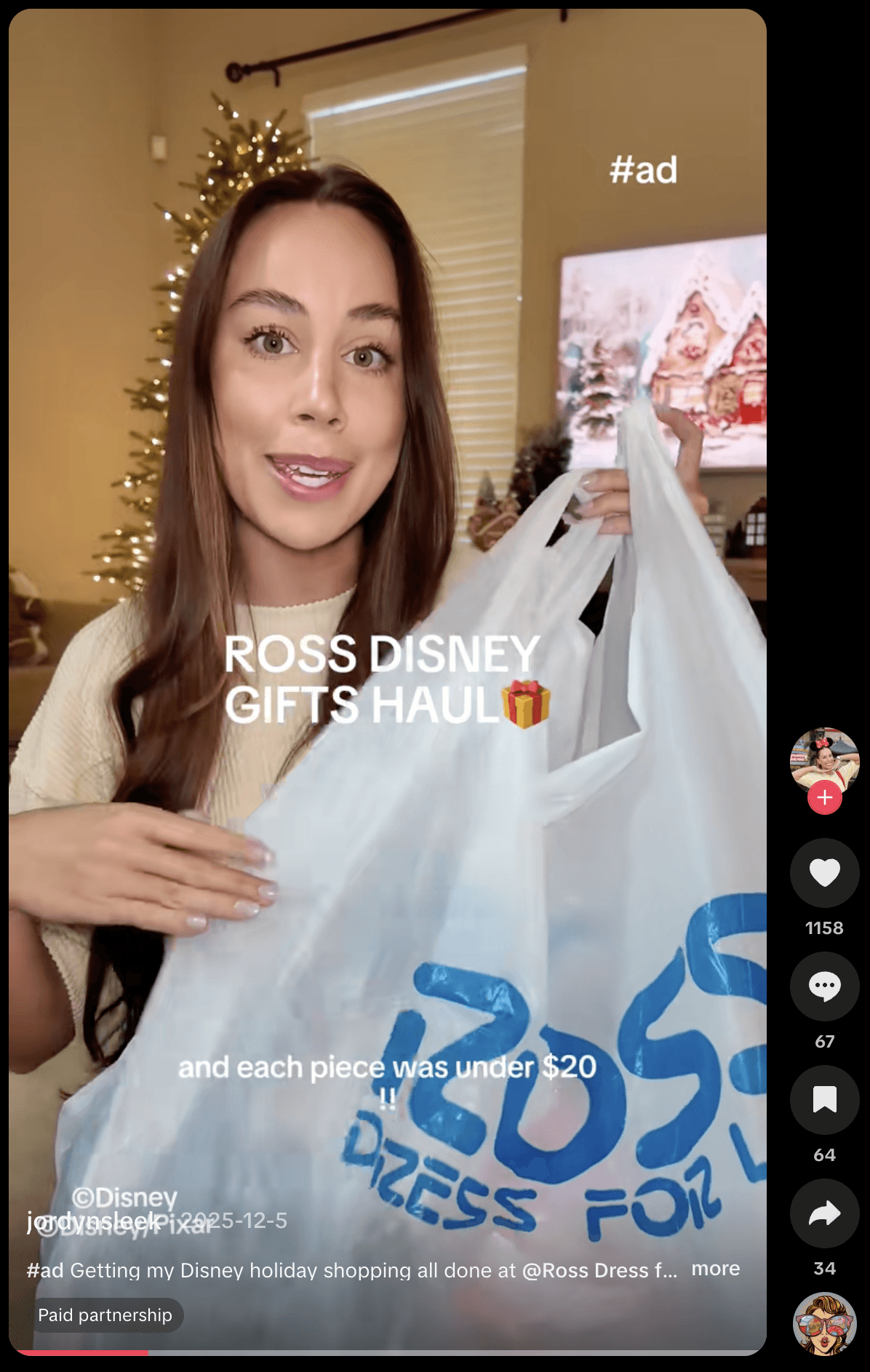
Content Summary (generated by Syncly AI):The content creator shares Disney gift ideas from Ross, including jewelry, earrings, a Stitch-themed stocking stuffer, a Christmas blanket, and gifts for her niece and nephew.
2) Vibe Density (Experience per visit)
Retail “feels” like the product—decor, atmosphere, social ritual.
Marketing implication: Pick your lane per campaign.
Value campaigns need clear economics. Vibe campaigns need filmable moments.
Holiday Marketing Strategy 2026: The Action Checklist
If 2025 taught us anything, it’s that operations + trust + emotional framing are now core marketing levers.
1) Move the calendar earlier
Launch by early October to capture planners with “done-before-December” energy
2) Build two journeys (Planner vs Rescue)
Separate landing pages, creative, and offers
3) Engineer self-gifting into the funnel
Gift + treat bundles
checkout treat modules
gift card kicker programs
4) Make convenience a headline
clear shipping cutoff banners
fast pickup messaging
curated gift solutions
5) Invest in social video listening
Track spoken mentions + on-screen text, not just hashtags
Use it to detect early shifts in sentiment (stress, trust, pain points)
FAQ: 2025 Holiday Shopping Trends
Q: Did shoppers start earlier in 2025?
A: Yes—early shopping was framed as a stress reduction strategy and identity signal.
Q: What drove self-gifting?
A: Holiday labor + stress increased demand for small, controllable rewards.
Q: What should brands do differently in 2026?
A: Start earlier, run two funnels, and treat trust + convenience as growth drivers.
This 2025 holiday shopping recap is grounded in short-form social video listening across TikTok and Instagram Reels. We analyzed creator videos using spoken-word transcripts, captions, and repeated content formats to identify the season’s most consistent behavioral and sentiment patterns.
The headline insight: holiday spending didn’t freeze. It evolved. Shoppers became more calculated, optimizing for control (budgeting), convenience (delivery + pickup), and emotional payoff (self-gifting).
Methodology: Short-form Social Video Listening (TikTok + Instagram Reels)
This analysis synthesizes themes from the provided dataset of short-form social videos using:
Transcripts (what creators say out loud)
Captions + on-screen text (what they frame as the hook)
Recurring formats (haul, unboxing, GRWM, store walkthroughs, gift guides)
Behavioral evidence (in-store footage, pickup workflows, shopping pain points)
Here's how the high-level metrics unfolded in this analysis:
Total Volume: 2,147 posts (TikTok leads with 1,172 vs. Instagram 975)
Total Views: 368.4M (TikTok dominates with 342.8M views vs. Instagram 25.6M)
Engagement: 7.3M total (TikTok drives 6.9M, indicating higher viral potential)
2025 Holiday Shopping Recap: The Rise of the “Calculated Shopper”
Holiday 2025 was defined by a contradiction that showed up repeatedly in social video:
Economic anxiety (prices, household budgeting pressure)
Strategic spending (shopping earlier, optimizing deals, limiting impulse)
Small treat behavior (self-gifting as emotional regulation)
Shoppers weren’t saying, “I’m not spending.” They were saying, “I’m spending differently.”
Social video evidence (gift-on-a-budget framing):
Capital One budget gifting tips: https://www.tiktok.com/@capitalone/video/7581950291411619085

Content Summary (generated by Syncly AI): The content creator shares tips to make the holidays magical while staying on budget.
Holiday Shopping Trends 2025: Early Planners vs Last-Minute Rescue Shoppers
Short-form videos made one thing obvious: the season split into two different shopper journeys.
Segment 1: Early Planners (“Finishers”)
Creators framed early shopping as a lifestyle win—peace, organization, and less stress.
“Done before December” = status + sanity
Curated lists and one-stop shops reduce decision fatigue
Evidence (early shopping haul framing):
Walmart early holiday shopping: https://www.instagram.com/reels/DRP-0xCiUTT/

Content Summary (generated by Syncly AI): The content creator shares her early holiday shopping haul from Walmart, featuring gifts for her nieces and son.
Segment 2: Last-Minute Rescue Shoppers
Late shoppers weren’t optimizing price as much as optimizing certainty:
in-stock availability
delivery speed
low-effort gift solutions (bundles, stocking stuffers, “grab-and-go”)
Evidence (last-minute store run + chaos):
Target/TJ Maxx/Sam’s Club last-minute shopping: https://www.tiktok.com/@_mariclaremaclamroc_/video/7586792286122511671

Content Summary (generated by Syncly AI): A content creator documents their last-minute Christmas shopping trip for two four-year-olds at Target, TJ Maxx, and Sam's Club.
Marketing implication: Run two funnels.
Planner funnel: early access, curated gifts, “finish early” messaging
Rescue funnel: shipping cutoffs, BOPIS, express delivery, “gift in minutes” bundles
Holiday Consumer Behavior 2025: Budgeting Became a Ritual
Budgeting wasn’t just a constraint—it became content. Shoppers shared tactics and mindset rules:
spend-per-person caps
list-making and strict prioritization
“experiences over things” as a budget-safe narrative
Evidence (macro-to-wallet explanation + household spending pressure):
Tariffs + household budget stress: https://www.tiktok.com/@sheisapaigeturner/video/7576360223770758414

Content Summary (generated by Syncly AI): The content creator discusses how tariffs are driving up the cost of everyday goods and impacting families' budgets.
Marketing implication: If you want conversion, don’t just say “sale.”
Show why it’s worth it (value proof, utility, durability, bundle economics).
Self-Gifting Trend 2025: “Treat Yourself” as a Conversion Driver
Self-gifting wasn’t an afterthought—it was a conversion lever. Creators repeatedly normalized:
“Don’t forget yourself”
adding small items during gift shopping
low-ticket “little treats” as emotional payoff for holiday labor
Evidence (“treat yourself too” positioned as part of gifting):
Amazon “11 cent deal day” gifting + self treat: https://www.tiktok.com/@okaylookingdude/video/7571479169347947806

Content Summary (generated by Syncly AI): The content creator discusses how tariffs are driving up the cost of everyday goods and impacting families' budgets.
What marketers should do:
Add a “Pick a little treat” module at checkout (AOV lift)
Build “Gift + Treat” bundles (guilt-reduction = higher conversion)
Use offer framing that validates the shopper’s effort (“you earned this”)
The Mall Comeback: Why Social Video Pulled Shoppers Back In-Store
A strong holiday signal: in-store shopping returned as experience + content.
Mall trips were filmed as a social ritual (“sister date,” festive vibes)
Physical retail became a content backdrop for “shop with me” formats
Visual merchandising mattered because it became shareable media
Evidence (mall as vibe + social ritual):
“Meet me at the mall” holiday shopping: https://www.tiktok.com/@meriahchristine1/video/7579031424758566174

Content Summary (generated by Syncly AI): The content creator discusses how tariffs are driving up the cost of everyday goods and impacting families' budgets.
Marketing implication: Stores aren’t just distribution. They’re a media channel.
For the 2026 Holiday Shopping Season, Brands should design for:
“filmable” curated gift corners
obvious giftable moments
quick, confidence-building wayfinding
Holiday Shopping Pain Points: Burnout, Overstimulation, Decision Fatigue
Short-form video captured real friction—especially for parents:
overcrowded aisles and overstimulation
decision fatigue from endless options
the mental load of managing family gifting
Evidence (overwhelm + preference for curated solutions):
Nordstrom curated lists + easy pickup + easy returns: https://www.tiktok.com/@sydneyschiffer/video/7585282386997398797

Content Summary (generated by Syncly AI): The content creator promotes Nordstrom as a great place to shop for holiday gifts, both online and in-store.
Marketing implication: Convenience is not a feature. It’s a premium benefit.
Highlight:
curated gift lists
BOPIS speed
returns clarity
“stocking stuffer bundles” and “gift-ready sets”
What Worked in 2025: Value Density vs Vibe Density
Winning holiday strategies are clustered into two lanes:
1) Value Density (Extreme value per frame)
Hauls succeed when a creator can show many items for a low total. Discount retailers thrive because “visual abundance” drives engagement
Evidence (under $20 gift haul):
Ross Disney gift ideas: https://www.tiktok.com/@jordynsleek/video/7580064190086270222

Content Summary (generated by Syncly AI):The content creator shares Disney gift ideas from Ross, including jewelry, earrings, a Stitch-themed stocking stuffer, a Christmas blanket, and gifts for her niece and nephew.
2) Vibe Density (Experience per visit)
Retail “feels” like the product—decor, atmosphere, social ritual.
Marketing implication: Pick your lane per campaign.
Value campaigns need clear economics. Vibe campaigns need filmable moments.
Holiday Marketing Strategy 2026: The Action Checklist
If 2025 taught us anything, it’s that operations + trust + emotional framing are now core marketing levers.
1) Move the calendar earlier
Launch by early October to capture planners with “done-before-December” energy
2) Build two journeys (Planner vs Rescue)
Separate landing pages, creative, and offers
3) Engineer self-gifting into the funnel
Gift + treat bundles
checkout treat modules
gift card kicker programs
4) Make convenience a headline
clear shipping cutoff banners
fast pickup messaging
curated gift solutions
5) Invest in social video listening
Track spoken mentions + on-screen text, not just hashtags
Use it to detect early shifts in sentiment (stress, trust, pain points)
FAQ: 2025 Holiday Shopping Trends
Q: Did shoppers start earlier in 2025?
A: Yes—early shopping was framed as a stress reduction strategy and identity signal.
Q: What drove self-gifting?
A: Holiday labor + stress increased demand for small, controllable rewards.
Q: What should brands do differently in 2026?
A: Start earlier, run two funnels, and treat trust + convenience as growth drivers.
This 2025 holiday shopping recap is grounded in short-form social video listening across TikTok and Instagram Reels. We analyzed creator videos using spoken-word transcripts, captions, and repeated content formats to identify the season’s most consistent behavioral and sentiment patterns.
The headline insight: holiday spending didn’t freeze. It evolved. Shoppers became more calculated, optimizing for control (budgeting), convenience (delivery + pickup), and emotional payoff (self-gifting).
Methodology: Short-form Social Video Listening (TikTok + Instagram Reels)
This analysis synthesizes themes from the provided dataset of short-form social videos using:
Transcripts (what creators say out loud)
Captions + on-screen text (what they frame as the hook)
Recurring formats (haul, unboxing, GRWM, store walkthroughs, gift guides)
Behavioral evidence (in-store footage, pickup workflows, shopping pain points)
Here's how the high-level metrics unfolded in this analysis:
Total Volume: 2,147 posts (TikTok leads with 1,172 vs. Instagram 975)
Total Views: 368.4M (TikTok dominates with 342.8M views vs. Instagram 25.6M)
Engagement: 7.3M total (TikTok drives 6.9M, indicating higher viral potential)
2025 Holiday Shopping Recap: The Rise of the “Calculated Shopper”
Holiday 2025 was defined by a contradiction that showed up repeatedly in social video:
Economic anxiety (prices, household budgeting pressure)
Strategic spending (shopping earlier, optimizing deals, limiting impulse)
Small treat behavior (self-gifting as emotional regulation)
Shoppers weren’t saying, “I’m not spending.” They were saying, “I’m spending differently.”
Social video evidence (gift-on-a-budget framing):
Capital One budget gifting tips: https://www.tiktok.com/@capitalone/video/7581950291411619085

Content Summary (generated by Syncly AI): The content creator shares tips to make the holidays magical while staying on budget.
Holiday Shopping Trends 2025: Early Planners vs Last-Minute Rescue Shoppers
Short-form videos made one thing obvious: the season split into two different shopper journeys.
Segment 1: Early Planners (“Finishers”)
Creators framed early shopping as a lifestyle win—peace, organization, and less stress.
“Done before December” = status + sanity
Curated lists and one-stop shops reduce decision fatigue
Evidence (early shopping haul framing):
Walmart early holiday shopping: https://www.instagram.com/reels/DRP-0xCiUTT/

Content Summary (generated by Syncly AI): The content creator shares her early holiday shopping haul from Walmart, featuring gifts for her nieces and son.
Segment 2: Last-Minute Rescue Shoppers
Late shoppers weren’t optimizing price as much as optimizing certainty:
in-stock availability
delivery speed
low-effort gift solutions (bundles, stocking stuffers, “grab-and-go”)
Evidence (last-minute store run + chaos):
Target/TJ Maxx/Sam’s Club last-minute shopping: https://www.tiktok.com/@_mariclaremaclamroc_/video/7586792286122511671

Content Summary (generated by Syncly AI): A content creator documents their last-minute Christmas shopping trip for two four-year-olds at Target, TJ Maxx, and Sam's Club.
Marketing implication: Run two funnels.
Planner funnel: early access, curated gifts, “finish early” messaging
Rescue funnel: shipping cutoffs, BOPIS, express delivery, “gift in minutes” bundles
Holiday Consumer Behavior 2025: Budgeting Became a Ritual
Budgeting wasn’t just a constraint—it became content. Shoppers shared tactics and mindset rules:
spend-per-person caps
list-making and strict prioritization
“experiences over things” as a budget-safe narrative
Evidence (macro-to-wallet explanation + household spending pressure):
Tariffs + household budget stress: https://www.tiktok.com/@sheisapaigeturner/video/7576360223770758414

Content Summary (generated by Syncly AI): The content creator discusses how tariffs are driving up the cost of everyday goods and impacting families' budgets.
Marketing implication: If you want conversion, don’t just say “sale.”
Show why it’s worth it (value proof, utility, durability, bundle economics).
Self-Gifting Trend 2025: “Treat Yourself” as a Conversion Driver
Self-gifting wasn’t an afterthought—it was a conversion lever. Creators repeatedly normalized:
“Don’t forget yourself”
adding small items during gift shopping
low-ticket “little treats” as emotional payoff for holiday labor
Evidence (“treat yourself too” positioned as part of gifting):
Amazon “11 cent deal day” gifting + self treat: https://www.tiktok.com/@okaylookingdude/video/7571479169347947806

Content Summary (generated by Syncly AI): The content creator discusses how tariffs are driving up the cost of everyday goods and impacting families' budgets.
What marketers should do:
Add a “Pick a little treat” module at checkout (AOV lift)
Build “Gift + Treat” bundles (guilt-reduction = higher conversion)
Use offer framing that validates the shopper’s effort (“you earned this”)
The Mall Comeback: Why Social Video Pulled Shoppers Back In-Store
A strong holiday signal: in-store shopping returned as experience + content.
Mall trips were filmed as a social ritual (“sister date,” festive vibes)
Physical retail became a content backdrop for “shop with me” formats
Visual merchandising mattered because it became shareable media
Evidence (mall as vibe + social ritual):
“Meet me at the mall” holiday shopping: https://www.tiktok.com/@meriahchristine1/video/7579031424758566174

Content Summary (generated by Syncly AI): The content creator discusses how tariffs are driving up the cost of everyday goods and impacting families' budgets.
Marketing implication: Stores aren’t just distribution. They’re a media channel.
For the 2026 Holiday Shopping Season, Brands should design for:
“filmable” curated gift corners
obvious giftable moments
quick, confidence-building wayfinding
Holiday Shopping Pain Points: Burnout, Overstimulation, Decision Fatigue
Short-form video captured real friction—especially for parents:
overcrowded aisles and overstimulation
decision fatigue from endless options
the mental load of managing family gifting
Evidence (overwhelm + preference for curated solutions):
Nordstrom curated lists + easy pickup + easy returns: https://www.tiktok.com/@sydneyschiffer/video/7585282386997398797

Content Summary (generated by Syncly AI): The content creator promotes Nordstrom as a great place to shop for holiday gifts, both online and in-store.
Marketing implication: Convenience is not a feature. It’s a premium benefit.
Highlight:
curated gift lists
BOPIS speed
returns clarity
“stocking stuffer bundles” and “gift-ready sets”
What Worked in 2025: Value Density vs Vibe Density
Winning holiday strategies are clustered into two lanes:
1) Value Density (Extreme value per frame)
Hauls succeed when a creator can show many items for a low total. Discount retailers thrive because “visual abundance” drives engagement
Evidence (under $20 gift haul):
Ross Disney gift ideas: https://www.tiktok.com/@jordynsleek/video/7580064190086270222

Content Summary (generated by Syncly AI):The content creator shares Disney gift ideas from Ross, including jewelry, earrings, a Stitch-themed stocking stuffer, a Christmas blanket, and gifts for her niece and nephew.
2) Vibe Density (Experience per visit)
Retail “feels” like the product—decor, atmosphere, social ritual.
Marketing implication: Pick your lane per campaign.
Value campaigns need clear economics. Vibe campaigns need filmable moments.
Holiday Marketing Strategy 2026: The Action Checklist
If 2025 taught us anything, it’s that operations + trust + emotional framing are now core marketing levers.
1) Move the calendar earlier
Launch by early October to capture planners with “done-before-December” energy
2) Build two journeys (Planner vs Rescue)
Separate landing pages, creative, and offers
3) Engineer self-gifting into the funnel
Gift + treat bundles
checkout treat modules
gift card kicker programs
4) Make convenience a headline
clear shipping cutoff banners
fast pickup messaging
curated gift solutions
5) Invest in social video listening
Track spoken mentions + on-screen text, not just hashtags
Use it to detect early shifts in sentiment (stress, trust, pain points)
FAQ: 2025 Holiday Shopping Trends
Q: Did shoppers start earlier in 2025?
A: Yes—early shopping was framed as a stress reduction strategy and identity signal.
Q: What drove self-gifting?
A: Holiday labor + stress increased demand for small, controllable rewards.
Q: What should brands do differently in 2026?
A: Start earlier, run two funnels, and treat trust + convenience as growth drivers.


Build a brand customers love with Syncly


Build a brand customers love with Syncly